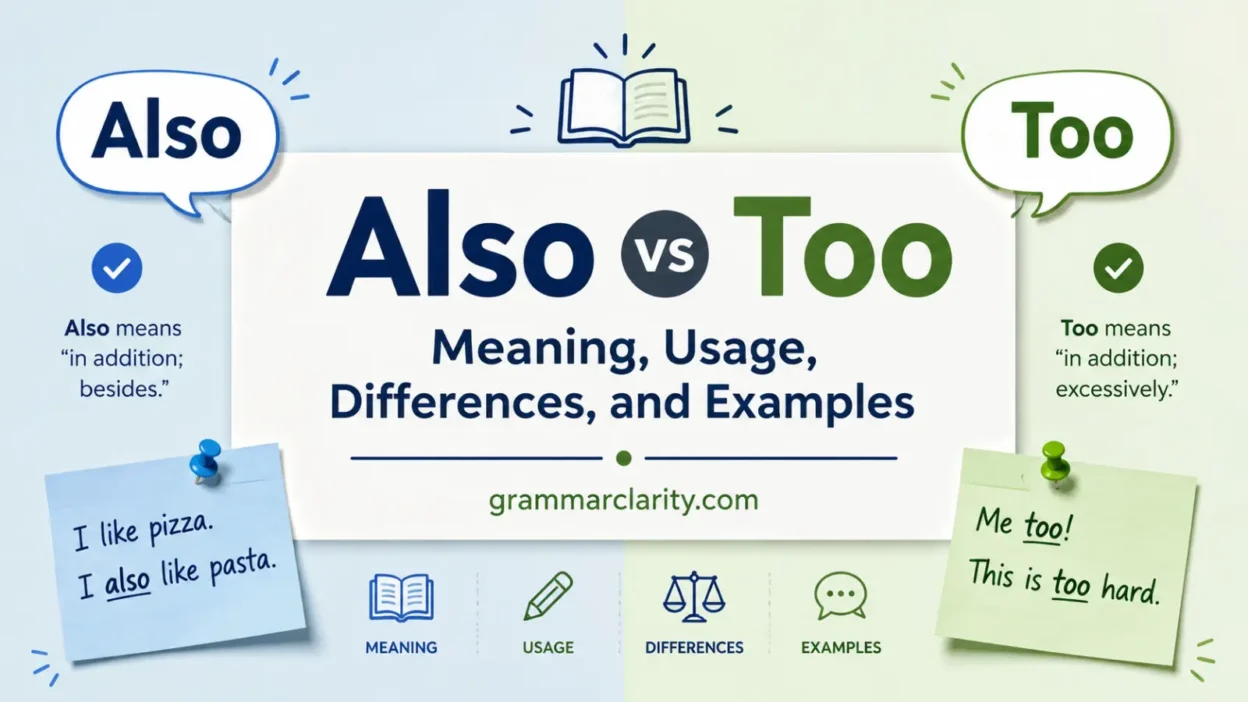
Many English learners and even native speakers occasionally wonder whether they should use also or too. Both words are common in everyday English, and both can add information that is already true about another person, thing, or situation.
Because they often express a similar idea, people frequently treat them as interchangeable. However, they are not always used in the same position within a sentence, and they can create different tones.
Understanding the difference between also and too helps your writing sound more natural and your speech more fluent. The good news is that the distinction is straightforward once you understand how each word works.
Quick Answer
Both also and too mean “in addition” or “as well.”
- Also usually appears before the main verb or after a helping verb.
- Too usually appears at the end of a sentence.
- Also often sounds slightly more formal.
- Too sounds more conversational and is very common in everyday speech.
Examples:
- I also enjoy hiking.
- I enjoy hiking too.
Both sentences are correct and express nearly the same meaning.
Why People Confuse Them
People confuse also and too because they often communicate the same basic idea. In many situations, either word can be used without changing the meaning significantly.
Consider these examples:
- She likes pizza, and I also like pizza.
- She likes pizza, and I like pizza too.
The message remains the same. Both sentences show that the speaker shares the same preference.
The confusion becomes greater because English allows flexibility in sentence structure. Learners often see both words used in similar contexts and assume they always work the same way.
However, placement and tone create important differences.
Key Differences At A Glance
| Context | Best Choice | Why |
|---|---|---|
| Formal writing | Also | Sounds slightly more formal |
| Academic papers | Also | Common in structured writing |
| Casual conversation | Too | Natural and conversational |
| End of sentence | Too | Most common position |
| Before main verb | Also | Fits standard sentence structure |
| Friendly emails | Too | Sounds relaxed and natural |
| Business reports | Also | Often preferred in professional writing |
| Everyday speaking | Too | Frequently used by native speakers |
Quick Comparison
| Feature | Also | Too |
|---|---|---|
| Meaning | In addition | In addition |
| Formality | Slightly formal | More casual |
| Common Position | Before main verb | End of sentence |
| Common in Speech | Yes | Very common |
| Common in Writing | Very common | Common |
Meaning and Usage Difference
The primary similarity is that both words mean “in addition” or “as well.”
The difference is usually about placement and style rather than meaning.
Using Also
Also is typically placed before the main verb.
Examples:
- I also enjoy classical music.
- She also works on weekends.
- They also visited Chicago during the trip.
When a helping verb is present, also often comes after it.
Examples:
- She has also completed the project.
- We are also considering other options.
- They have also agreed to the proposal.
This placement makes sentences sound organized and polished.
Using Too
Too is commonly placed at the end of a sentence.
Examples:
- I enjoy classical music too.
- She works on weekends too.
- They visited Chicago too.
This structure feels natural and conversational.
Native speakers frequently choose too in everyday speech because it flows smoothly and sounds friendly.
Can They Be Interchanged?
Often, yes.
Compare:
- I also need a copy.
- I need a copy too.
Both are correct.
However, the sentence structure changes, and one may sound more natural depending on the context.
Tone, Context, and Formality
One of the most useful ways to understand the difference is through tone.
Also in Formal Contexts
Also appears frequently in:
- Academic writing
- Professional emails
- Business reports
- News articles
- Research papers
Examples:
- The company also announced new hiring plans.
- Researchers also identified additional factors.
- The report also highlights safety concerns.
These sentences sound professional and polished.
Too in Casual Contexts
Too is common in:
- Conversations
- Text messages
- Informal emails
- Social media posts
- Friendly discussions
Examples:
- I want to go too.
- That movie was great too.
- I’m excited about it too.
These examples sound natural and relaxed.
When Tone Matters
Imagine writing a business report:
- The team also achieved its quarterly goals.
This sounds professional.
Now compare:
- The team achieved its quarterly goals too.
This is still correct but may sound slightly less formal.
Which One Should You Use?
The best choice depends on your audience and purpose.
Use also when:
- Writing formally
- Creating academic content
- Preparing professional documents
- Maintaining a structured tone
Use too when:
- Speaking casually
- Texting friends
- Writing conversational content
- Creating a relaxed tone
A useful guideline is simple:
If you want a polished tone, choose also.
If you want a natural conversational tone, choose too.
When One Choice Sounds Wrong
Although both words often express the same idea, they do not fit naturally in every position.
Incorrect Placement of Also
Incorrect:
- I like coffee also every morning.
Natural:
- I also like coffee every morning.
Incorrect Placement of Too
Less natural:
- Too I enjoy reading.
Natural:
- I enjoy reading too.
Overusing Both Together
Incorrect:
- I also like pizza too.
Correct:
- I also like pizza.
- I like pizza too.
Using both usually creates unnecessary repetition.
Formal Documents
In formal writing, repeated use of too may sound overly conversational.
Example:
- The report identified budget concerns. It found staffing issues too.
More formal:
- The report identified budget concerns. It also found staffing issues.
Common Mistakes (and Quick Fixes)
Mistake 1: Using Both Words Together
Incorrect:
- She also came too.
Correct:
- She also came.
- She came too.
Mistake 2: Putting Also in an Awkward Position
Incorrect:
- Also I enjoy swimming.
Better:
- I also enjoy swimming.
Mistake 3: Using Too at the Beginning
Unnatural:
- Too I wanted to help.
Better:
- I wanted to help too.
Mistake 4: Choosing Too in Highly Formal Writing
Less formal:
- The study found new evidence too.
More formal:
- The study also found new evidence.
Mistake 5: Forgetting Sentence Flow
Always read the sentence aloud.
If the sentence sounds stiff or awkward, adjusting the placement of also or too often improves it.
Everyday Examples
Below are realistic examples showing how native speakers use these words.
At Work
- I also reviewed the financial report.
- I reviewed the financial report too.
At School
- She also joined the science club.
- She joined the science club too.
During Travel
- We also visited Seattle.
- We visited Seattle too.
Family Conversations
- Dad also wants to come.
- Dad wants to come too.
Shopping
- I also bought some snacks.
- I bought some snacks too.
Fitness
- She also goes to the gym on weekends.
- She goes to the gym on weekends too.
Entertainment
- I also watched that show.
- I watched that show too.
Technology
- The app also works offline.
- The app works offline too.
Food
- They also ordered dessert.
- They ordered dessert too.
Sports
- He also plays basketball.
- He plays basketball too.
Dictionary-Style Word Details
Verb
Also: Not commonly used as a verb in standard US English.
Too: Not commonly used as a verb in standard US English.
Noun
Also: Not commonly used as a noun in standard US English.
Too: Not commonly used as a noun in standard US English.
Synonyms
Also:
- Additionally
- Furthermore
- Moreover
- As well
- Besides
Too:
- As well
- In addition
- Also
- Likewise
Closest plain alternatives for both:
- As well
- In addition
Clear antonyms generally do not apply because both words function as additive adverbs rather than direct opposites.
Example Sentences
Also
- The restaurant also offers vegetarian options.
- We also need additional supplies.
- She also attended the conference.
- The software also supports mobile devices.
- They also volunteered during the event.
Too
- I want a ticket too.
- She enjoyed the concert too.
- They are coming too.
- We liked the restaurant too.
- He wants to participate too.
Word History
Also
- A long-established English word used to indicate addition or inclusion.
- It has been part of English for centuries and remains common in both speech and writing.
Too
- A long-established English word that can mean “in addition” and, in other contexts, “excessively.”
- When comparing also vs too, the focus is on the “in addition” meaning.
Phrases Containing
Also
- Also known as
- Also included
- Also available
- Also noted
- Also recommended
Too
- Me too
- You too
- Too late
- Too much
- Too many
FAQs
Is it correct to say “also” and “too” in the same sentence?
Usually no. Since both words often express the same idea, using both together can sound repetitive.
Incorrect:
- I also like coffee too.
Correct:
- I also like coffee.
- I like coffee too.
Which is more formal, also or too?
Also is generally considered more formal than too and is often preferred in academic and professional writing.
Can also and too have the same meaning?
Yes. In many situations, both mean “in addition” or “as well.”
Where should I place also in a sentence?
Usually before the main verb or after a helping verb.
Examples:
- I also agree.
- She has also finished.
Where should I place too in a sentence?
Most commonly at the end of a sentence.
Examples:
- I agree too.
- She finished too.
Do native English speakers use too more often?
In casual conversation, many native speakers frequently use too because it sounds natural and friendly.
Is “me too” correct English?
Yes. “Me too” is one of the most common expressions in everyday English and means that the speaker shares the same feeling, opinion, or experience.
Can I use also in academic writing?
Yes. Also is widely used in essays, reports, research papers, and other formal writing.
Is too always informal?
No. It is acceptable in many types of writing, but it generally sounds more conversational than also.
Which should English learners use more often?
Learn both. Use also for formal writing and too for casual conversation. Understanding when each sounds most natural will improve your overall fluency.
Conclusion
The difference between also and too is mainly about sentence position and tone rather than meaning.
Both words can mean “in addition” or “as well.” The choice often depends on how formal you want your sentence to sound.
Use also when you want a more polished or professional tone. It usually appears before the main verb or after a helping verb.
Use too when you want a natural, conversational tone. It most often appears at the end of a sentence.
In everyday American English, both words are extremely common and usually easy to understand. Once you learn their typical placement and tone, choosing between also and too becomes much simpler.