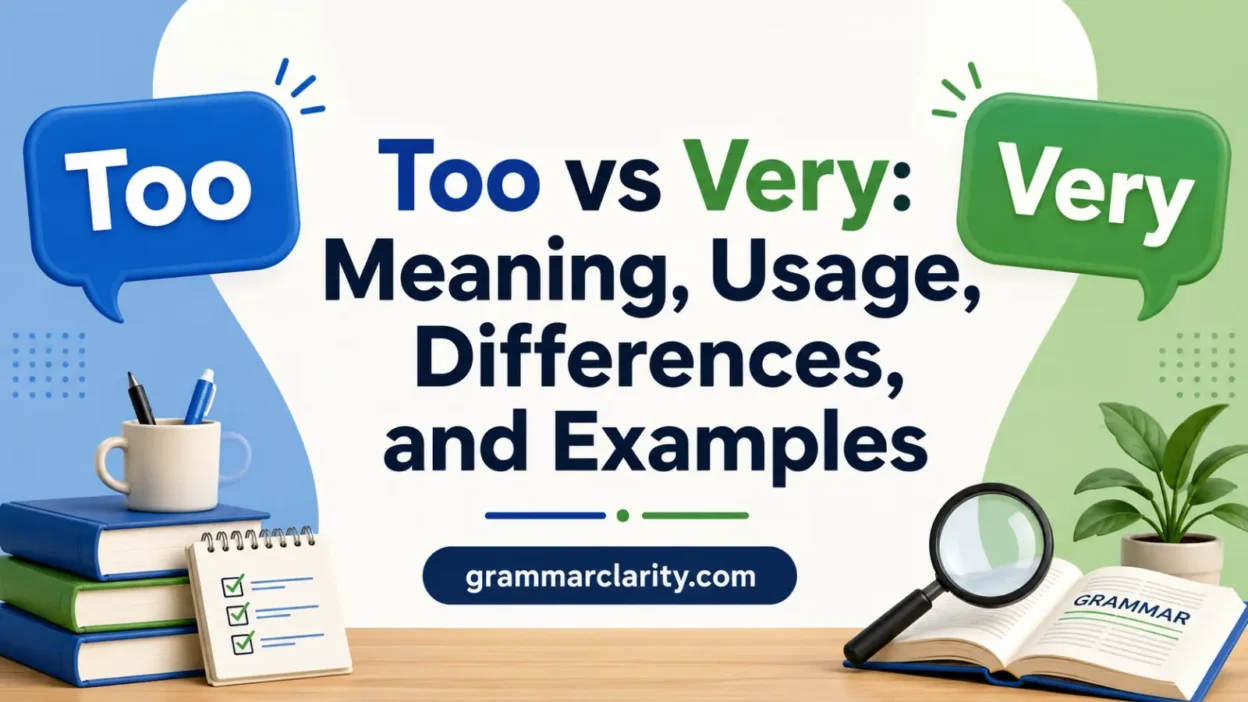
Many English learners confuse too and very because both words are used to strengthen descriptions. They often appear before adjectives and adverbs, which makes them look similar at first glance.
However, they do not mean the same thing.
The difference is important because using the wrong word can completely change the meaning of a sentence. In some situations, replacing very with too makes a sentence sound negative or unintended.
Understanding when to use each word will help you speak and write more naturally in American English.
Quick Answer
The simplest difference is this:
- Very means to a high degree.
- Too means more than needed, more than wanted, or excessively.
Compare these examples:
- The coffee is very hot. (Hot to a high degree.)
- The coffee is too hot. (So hot that it creates a problem.)
In most situations:
- Use very for strong description.
- Use too when something exceeds an acceptable limit.
Why People Confuse Them
People confuse these words because both intensify adjectives and adverbs.
Consider these sentences:
- The room is very cold.
- The room is too cold.
Both sentences indicate a low temperature.
The difference is that the first sentence simply describes the temperature, while the second suggests the temperature is a problem.
This subtle distinction causes many learners to use too when they really mean very.
Another reason for confusion is that both words frequently appear before common adjectives such as:
- hot
- cold
- expensive
- loud
- difficult
- fast
- slow
Because the sentence structure looks similar, learners may overlook the difference in meaning.
Key Differences At A Glance
| Context | Best Choice | Why |
|---|---|---|
| Strong description | Very | Shows a high degree |
| Excessive amount | Too | Shows more than desired |
| Neutral statement | Very | No negative meaning |
| Problem or limitation | Too | Indicates an issue |
| Positive compliment | Very | Sounds natural |
| Warning or complaint | Too | Suggests excess |
| Formal writing | Both | Depends on intended meaning |
| Everyday conversation | Both | Depends on context |
Quick Comparison
| Feature | Too | Very |
| Shows intensity | Yes | Yes |
| Suggests excess | Yes | No |
| Often implies a problem | Yes | No |
| Neutral meaning | Usually no | Yes |
| Common in complaints | Yes | Less often |
| Common in compliments | Less often | Very common |
Meaning and Usage Difference
The most important distinction is that very increases intensity, while too suggests excess.
Using Very
Very strengthens an adjective or adverb without suggesting anything negative.
Examples:
- The movie was very interesting.
- She is very talented.
- The road was very narrow.
- He drove very carefully.
- The restaurant was very busy.
In these examples, the speaker simply describes something strongly.
No problem is implied.
Using Too
Too usually means more than necessary, acceptable, desirable, or possible.
Examples:
- The movie was too long.
- She is too tired to work.
- The road is too narrow for trucks.
- He drove too fast.
- The restaurant was too crowded.
These examples suggest a negative result or limitation.
The “Too + Infinitive” Structure
One common pattern is:
too + adjective + to + verb
Examples:
- Too tired to continue.
- Too young to drive.
- Too busy to help.
- Too late to change plans.
- Too expensive to buy.
This structure shows that the excessive quality prevents something from happening.
Comparing Meanings
Consider these pairs:
- The bag is very heavy.
- The bag is too heavy.
The first sentence describes weight.
The second sentence suggests the weight causes difficulty.
Another pair:
- The music is very loud.
- The music is too loud.
The first simply describes volume.
The second indicates the volume exceeds what is comfortable or acceptable.
Tone, Context, and Formality
Both words are standard in formal and informal English.
The difference lies more in tone than formality.
Tone of Very
Very sounds neutral.
Examples:
- very helpful
- very good
- very successful
- very professional
- very effective
It commonly appears in compliments and positive descriptions.
Examples:
- She did a very good job.
- The presentation was very informative.
- Your idea is very creative.
Tone of Too
Too often sounds critical or negative because it suggests excess.
Examples:
- too noisy
- too expensive
- too difficult
- too slow
- too risky
Examples:
- The ticket is too expensive.
- The music is too loud.
- The line is too long.
These statements imply dissatisfaction.
Positive Uses of Too
Sometimes too means “also.”
Examples:
- I want to come too.
- She likes pizza too.
However, that meaning is different from the comparison discussed in this article.
When comparing too and very as intensifiers, the focus is on excess versus intensity.
Which One Should You Use?
Ask yourself a simple question:
Is there a problem?
If there is no problem, use very.
Examples:
- very happy
- very smart
- very clean
- very warm
- very exciting
If something exceeds an acceptable limit, use too.
Examples:
- too hot
- too cold
- too expensive
- too noisy
- too dangerous
A quick test:
If you can add “for me,” “to use,” or “to handle,” then too may be correct.
Examples:
- Too heavy for me.
- Too difficult to understand.
- Too expensive to buy.
- Too loud to ignore.
When One Choice Sounds Wrong
Using too when you mean very can create unintended negativity.
Incorrect:
- She is too beautiful.
This may imply her beauty creates a problem.
Better:
- She is very beautiful.
Incorrect:
- The food was too good.
This sounds unusual because goodness is generally not a problem.
Better:
- The food was very good.
Although native speakers sometimes say things like “too good” for emphasis, they usually mean something special such as “surprisingly good” or “better than expected.”
Likewise, replacing too with very can remove an important meaning.
Incorrect:
- The box is very heavy to carry.
Better:
- The box is too heavy to carry.
The second sentence clearly explains that the weight prevents carrying.
Common Mistakes (and Quick Fixes)
Mistake 1: Using Too for Positive Description
Incorrect:
- The hotel was too nice.
Correct:
- The hotel was very nice.
Mistake 2: Using Very When Excess Is Intended
Incorrect:
- The room is very small for our family.
Correct:
- The room is too small for our family.
Mistake 3: Forgetting the Negative Meaning of Too
Incorrect:
- She is too kind.
Correct:
- She is very kind.
Unless kindness is causing a specific issue, very is usually the intended word.
Mistake 4: Confusing Too with Also
Incorrect understanding:
- I like coffee too.
Here too means “also,” not “excessively.”
Mistake 5: Misusing Too + Infinitive
Incorrect:
- The exam was very difficult to pass.
Correct:
- The exam was too difficult to pass.
The corrected sentence shows that difficulty prevented success.
Everyday Examples
Here are realistic examples from daily American English.
At Home
- The soup is very tasty.
- The soup is too salty.
- The couch is very comfortable.
- The couch is too large for the room.
At Work
- The project is very important.
- The deadline is too short.
- The meeting was very productive.
- The workload is too heavy.
At School
- The lesson was very interesting.
- The homework was too difficult.
- The teacher was very helpful.
- The classroom was too noisy.
Shopping
- This jacket is very stylish.
- This jacket is too expensive.
- The store is very popular.
- The line is too long.
Travel
- The beach was very beautiful.
- The weather was too hot.
- The hotel was very clean.
- The traffic was too heavy.
Dictionary-Style Word Details
Verb
Too: Not commonly used as a verb in standard US English.
Very: Not commonly used as a verb in standard US English.
Noun
Too: Not commonly used as a noun in standard US English.
Very: Rarely appears as a noun in modern usage and generally not relevant to everyday American English.
Synonyms
Too
Closest plain alternatives:
- excessively
- overly
- unduly
- extremely (in some contexts)
- more than necessary
Possible opposite ideas:
- sufficiently
- adequately
- reasonably
Very
Closest plain alternatives:
- extremely
- highly
- greatly
- particularly
- remarkably
Possible opposite ideas:
- slightly
- somewhat
- mildly
Example Sentences
Too
- The box is too heavy to lift.
- The music is too loud.
- The restaurant is too crowded.
- The road is too narrow.
- The dress is too expensive.
Very
- The box is very heavy.
- The music is very loud.
- The restaurant is very popular.
- The road is very narrow.
- The dress is very elegant.
Word History
Too
The modern English word developed from older forms that carried the idea of excess or addition. Its meaning of “more than enough” remains the primary sense in this comparison.
Very
The word developed through earlier stages of English and gradually became a common intensifier meaning “to a high degree.” It remains one of the most frequently used intensifiers in modern English.
Phrases Containing
Too
- too much
- too many
- too little
- too late
- too soon
- too good to be true
- too close for comfort
Very
- very well
- very good
- very much
- very little
- very likely
- very often
- very important
FAQs
Is it correct to say “too good”?
Yes. Native speakers sometimes say “too good” to mean surprisingly good, unrealistically good, or better than expected. However, “very good” is usually the safer and more neutral choice.
Can too and very be interchangeable?
No. While both intensify meaning, too usually implies excess or a problem, whereas very simply increases intensity.
Why does “too” often sound negative?
Because it commonly suggests something exceeds an acceptable limit. For example, “too loud” means louder than desired.
Can I use very before all adjectives?
Not all adjectives work naturally with very, but it is commonly used before many descriptive adjectives such as happy, tall, smart, busy, and expensive.
What is the easiest way to remember the difference?
Ask yourself whether there is a problem. If there is no problem, use very. If something exceeds a limit or creates difficulty, use too.
Is “very much” correct?
Yes. “Very much” is a common phrase used to strengthen verbs and expressions.
Examples:
- Thank you very much.
- I very much appreciate your help.
Can too be used positively?
Yes. It can mean “also” in sentences such as:
- I want to go too.
- She likes ice cream too.
However, that meaning is different from the excess meaning discussed in this comparison.
Which word is more common in daily conversation?
Both are extremely common. Very is often used for neutral descriptions, while too is frequently used when discussing problems, complaints, or limitations.
Conclusion
The difference between too and very comes down to excess versus intensity.
Use very when you simply want to strengthen a description.
Use too when something goes beyond an acceptable limit or creates a problem.
Compare these final examples:
- The coffee is very hot. (Strong description.)
- The coffee is too hot. (Hot enough to be a problem.)
Remember this simple rule:
Very = a high degree.
Too = more than necessary.
Mastering that distinction will help you avoid one of the most common mistakes in everyday English.