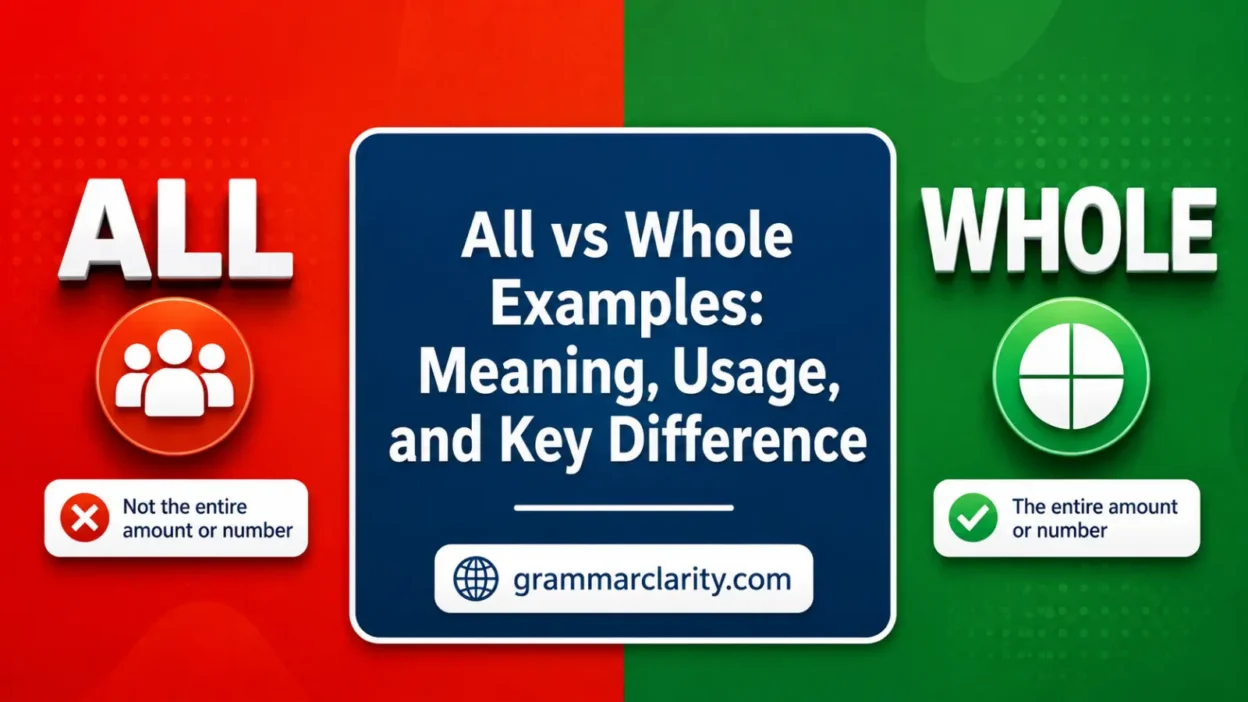
Many English learners and native speakers occasionally hesitate when choosing between all and whole. Both words can refer to completeness, and in some situations they seem very similar. However, they are not always interchangeable.
The difference matters because choosing the wrong one can make a sentence sound unnatural or grammatically incorrect. Consider these examples:
- I spent the whole day studying.
- I spent all day studying.
Both sound natural.
Now compare:
- The whole students attended the meeting. ❌
- All the students attended the meeting. ✅
Suddenly, the choice becomes important.
Understanding when to use all and when to use whole helps your writing sound more natural, fluent, and accurate. The good news is that the distinction is easier than many people think.
Quick Answer
Use all when referring to every member, amount, or part of something.
Use whole when referring to one complete thing as a single unit.
Examples:
- All the students passed the test.
- The whole class passed the test.
- All the cake was eaten.
- The whole cake was eaten.
In many situations both can be correct, but the structure and emphasis are different.
All focuses on every part collectively.
Whole focuses on the complete item as one unit.
Why People Confuse Them
People confuse these words because both often communicate the idea of completeness.
Consider these examples:
- I worked all week.
- I worked the whole week.
Both express a complete week.
- She read all the book.
- She read the whole book.
Only one is natural in standard American English.
Because the meanings overlap, learners sometimes assume the words follow identical grammar patterns. They do not.
Another reason for confusion is that English allows both words in many similar contexts:
- all day
- the whole day
- all year
- the whole year
- all morning
- the whole morning
When two words appear in nearly identical situations, it is easy to assume they are interchangeable everywhere. The grammar rules show otherwise.
Key Differences At A Glance
| Context | Best Choice | Why |
|---|---|---|
| Every person in a group | All | Refers to every member collectively |
| One complete object | Whole | Refers to a complete unit |
| Entire period of time | All or Whole | Both are often acceptable |
| Before plural nouns | All | Standard structure |
| Before singular countable nouns | Whole | Common and natural usage |
| Groups of people | All | Emphasizes every member |
| Single item | Whole | Emphasizes completeness |
| Formal and informal writing | Both | Choice depends on meaning |
Quick Comparison
| Feature | All | Whole |
| Focus | Every part or member | One complete unit |
| Works with plural nouns | Yes | Usually no |
| Works with singular count nouns | Limited | Yes |
| Common with groups | Yes | Less common |
| Common with complete objects | Sometimes | Very common |
| Meaning emphasis | Collectiveness | Completeness |
Meaning and Usage Difference
The core distinction is simple.
All means every part, every amount, or every member.
Whole means complete or entire.
Although those ideas overlap, they are not identical.
Using All
All often refers to every member of a group.
Examples:
- All students must submit the assignment.
- All employees attended the training session.
- All children received gifts.
In these examples, the focus is on every individual member.
All can also refer to total amounts.
Examples:
- All the water disappeared.
- All the money was spent.
- All the food was gone.
Here, the focus is on the entire quantity.
Using Whole
Whole emphasizes one complete thing.
Examples:
- I ate the whole pizza.
- She watched the whole movie.
- He read the whole article.
The focus is not on individual pieces but on the complete item.
Think of whole as highlighting something as one complete unit.
Time Expressions
This is one area where both words frequently appear.
Examples:
- I waited all day.
- I waited the whole day.
- It rained all night.
- It rained the whole night.
- She worked all year.
- She worked the whole year.
Both versions are usually acceptable.
However, some expressions are more common than others in everyday American English.
For example:
- all day
- all night
- all week
are extremely common.
Countable and Uncountable Nouns
All works comfortably with both countable and uncountable nouns.
Examples:
Countable:
- All students arrived.
- All books were returned.
Uncountable:
- All water evaporates eventually.
- All information was shared.
Whole is generally used with singular countable nouns.
Examples:
- the whole cake
- the whole city
- the whole building
- the whole story
This difference helps explain many common mistakes.
Tone, Context, and Formality
Neither word is inherently more formal.
Both appear in:
- conversations
- business writing
- journalism
- academic writing
- professional communication
The difference is usually one of focus rather than formality.
Natural Conversational Usage
People frequently say:
- I slept all day.
- We talked all night.
- She worked all weekend.
These sound effortless and natural.
Whole is also common:
- I watched the whole game.
- He ate the whole sandwich.
- She read the whole report.
Again, the focus is on one complete item.
Emphasis Differences
Compare:
- All the cookies were eaten.
- The whole cookie was eaten.
The first sentence refers to every cookie.
The second sentence refers to one cookie in its entirety.
That distinction is often the key to choosing correctly.
Professional Writing
Business writing commonly uses both.
Examples:
- All employees must complete the survey.
- The whole department participated.
- All documents were reviewed.
- The whole proposal was approved.
The choice depends on meaning, not formality.
Which One Should You Use?
A simple question can help.
Ask yourself:
Am I talking about every member or part?
If yes, use all.
Examples:
- All students graduated.
- All tickets sold out.
- All supplies arrived.
Now ask:
Am I talking about one complete thing?
If yes, use whole.
Examples:
- the whole building
- the whole project
- the whole cake
Easy Rule
Use all for collections.
Use whole for complete single units.
Examples:
- All the players celebrated.
- The whole team celebrated.
Both are correct, but the focus differs slightly.
The first emphasizes individual members.
The second emphasizes the team as one unit.
When One Choice Sounds Wrong
Certain structures immediately sound unnatural.
Incorrect Use of Whole With Plural Nouns
Incorrect:
- Whole students attended the lecture.
Correct:
- All students attended the lecture.
Incorrect Use of All With Singular Countable Nouns
Incorrect:
- All book was interesting.
Correct:
- The whole book was interesting.
Or:
- All of the book was interesting.
Incorrect Article Usage
Incorrect:
- Whole movie was exciting.
Correct:
- The whole movie was exciting.
Whole often needs an article such as:
- the
- a
- this
- that
Examples:
- the whole house
- the whole story
- the whole trip
Incorrect Quantity Meaning
Compare:
- All the cakes were sold.
- The whole cake was sold.
These sentences do not mean the same thing.
The first refers to multiple cakes.
The second refers to one complete cake.
Common Mistakes and Quick Fixes
Mistake 1
❌ Whole students arrived early.
✅ All students arrived early.
Mistake 2
❌ All movie was boring.
✅ The whole movie was boring.
Mistake 3
❌ Whole books were donated.
✅ All books were donated.
Mistake 4
❌ I ate all pizza.
✅ I ate the whole pizza.
Mistake 5
❌ Whole employees attended training.
✅ All employees attended training.
Mistake 6
❌ Whole people agreed.
✅ All people agreed.
Mistake 7
❌ All project was delayed.
✅ The whole project was delayed.
Mistake 8
❌ Whole reports were submitted.
✅ All reports were submitted.
Mistake 9
❌ Whole days it rained.
✅ It rained all day.
Mistake 10
❌ All building was renovated.
✅ The whole building was renovated.
Everyday Examples
The best way to master the difference is through real-life examples.
School
- All students passed the exam.
- The whole class passed the exam.
- All assignments were submitted.
- The whole assignment was completed correctly.
Work
- All employees attended the meeting.
- The whole department attended the meeting.
- All reports were reviewed.
- The whole report was reviewed carefully.
Home
- All dishes were washed.
- The whole kitchen was cleaned.
- All groceries were unpacked.
- The whole refrigerator was organized.
Entertainment
- I watched the whole movie.
- All episodes were released at once.
- We enjoyed the whole concert.
- All performers received applause.
Travel
- We spent all summer traveling.
- We enjoyed the whole trip.
- All flights were delayed.
- The whole journey took twelve hours.
Sports
- All players participated.
- The whole team celebrated.
- All tickets sold out.
- The whole stadium erupted with cheers.
Shopping
- All items were discounted.
- The whole store was crowded.
Health
- All appointments were confirmed.
- The whole process took less than an hour.
Family
- All relatives attended.
- The whole family attended.
Community
- All residents received notices.
- The whole neighborhood participated.
Dictionary-Style Word Details
Verb
All:
Not commonly used as a verb in standard American English.
Whole:
Not commonly used as a verb in standard American English.
Noun
All:
Can function as a pronoun or noun-like word referring to everything or everyone.
Examples:
- All is forgiven.
- All were welcomed.
Whole:
Can function as a noun meaning a complete amount or entirety.
Examples:
- The whole is greater than the sum of its parts.
- Consider the whole before judging.
Synonyms
All:
Closest plain alternatives:
- every
- each
- entire amount
- complete amount
- total
Possible opposites depending on context:
- none
- some
- part
Whole:
Closest plain alternatives:
- entire
- complete
- full
- intact
- undivided
Possible opposites depending on context:
- partial
- incomplete
- broken
- divided
Example Sentences
All:
- All students completed the survey.
- All guests arrived on time.
- All the food was eaten.
- All employees received training.
- All seats were occupied.
- All children deserve support.
- All documents were signed.
- All members voted.
- All tickets sold quickly.
- All information was verified.
Whole:
- The whole building was renovated.
- I watched the whole game.
- She spent the whole afternoon reading.
- He ate the whole sandwich.
- The whole project took months.
- We enjoyed the whole experience.
- The whole neighborhood celebrated.
- The whole story sounded believable.
- She cleaned the whole house.
- The whole event went smoothly.
Word History
All:
An old English word that has long been used to express the idea of totality, completeness, or every member of a group.
Whole:
An old English word related to ideas of completeness, entirety, and something remaining intact as one unit.
Both words have existed in English for centuries and continue to serve distinct but sometimes overlapping purposes.
Phrases Containing
All:
- all day
- all night
- all week
- all year
- all at once
- all along
- all over
- all together
- all set
- all right
Whole:
- the whole time
- the whole day
- the whole story
- the whole truth
- the whole world
- the whole family
- the whole thing
- the whole point
- the whole process
- the whole package
FAQs
Is it correct to say all day or the whole day?
Both are correct.
- I worked all day.
- I worked the whole day.
In everyday American English, all day is often more common.
Can all and whole mean the same thing?
Sometimes.
Examples:
- I stayed home all day.
- I stayed home the whole day.
Both communicate essentially the same idea.
Can whole be used with plural nouns?
Usually no.
Say:
- All students
Not:
- Whole students
Can all be used with singular nouns?
Sometimes, but the structure changes.
Examples:
- All of the book
- All of the cake
Many speakers prefer:
- the whole book
- the whole cake
Which word is better for groups of people?
Usually all.
Examples:
- All employees
- All students
- All voters
Which word is better for one complete object?
Usually whole.
Examples:
- the whole pizza
- the whole building
- the whole report
Is one word more formal than the other?
No.
Both are standard and widely accepted in formal and informal American English.
Why does “the whole team” sound natural?
Because the team is treated as one complete unit.
Why does “all the team” sound less common in American English?
American English usually prefers:
- all the team members
- the whole team
depending on the intended meaning.
What is the easiest way to remember the difference?
Remember this:
- All = every member or every part
- Whole = one complete thing
That simple distinction works in most situations.
Conclusion
The difference between all and whole comes down to focus. All highlights every member, part, or amount within a group, while whole highlights one complete thing viewed as a single unit. Although both words can sometimes appear in similar expressions, especially with time periods such as all day and the whole day, they follow different grammatical patterns.
When talking about groups, collections, or every individual item, choose all. When talking about one complete object, event, story, building, project, or experience, choose whole. Understanding that distinction makes it much easier to choose the natural option every time and avoid common usage mistakes.