Many English learners understand the basic meanings of too and enough, yet they often struggle when deciding which one fits a sentence correctly.
Although both words relate to quantity, degree, or amount, they express completely different ideas.
Too usually shows that something exceeds an acceptable limit. It suggests a problem, difficulty, or negative result.
Enough shows that something meets a required level. It indicates sufficiency and often suggests that a goal can be achieved.
Because both words often appear in similar situations, learners frequently confuse them. Understanding the difference can dramatically improve your speaking and writing accuracy.
This guide explains the distinction clearly, provides practical examples, highlights common mistakes, and shows exactly when each word should be used.
Quick Answer
The simplest difference is this:
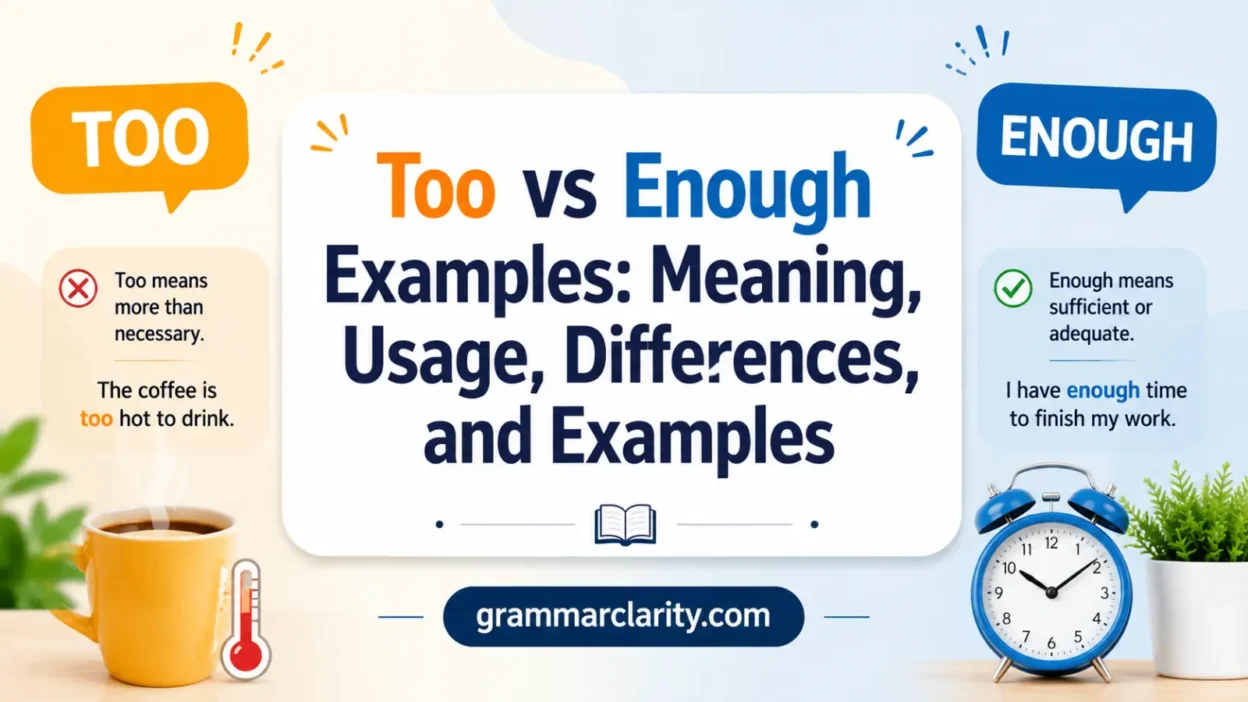
- Too means more than necessary or more than desired.
- Enough means as much as needed or sufficient.
Examples:
- The coffee is too hot to drink.
- The coffee is cool enough to drink.
In the first sentence, the heat creates a problem.
In the second sentence, the temperature is suitable.
Whenever something exceeds a limit, use too.
Whenever something meets a requirement, use enough.
Why People Confuse Them
People confuse these words because both are often used when discussing amounts, sizes, qualities, and conditions.
Consider these examples:
- The bag is too heavy.
- The bag is light enough.
Both sentences discuss weight.
However, the first sentence focuses on a problem.
The second focuses on adequacy.
Another reason for confusion is sentence structure.
Too usually appears before an adjective or adverb:
- too expensive
- too slowly
- too loudly
Enough often appears after an adjective or adverb:
- rich enough
- quickly enough
- carefully enough
Because the word positions differ, learners sometimes place them incorrectly.
Key Differences At A Glance
| Feature | Too | Enough |
| Main Meaning | More than needed | As much as needed |
| Suggests a Problem | Usually yes | Usually no |
| Indicates Sufficiency | No | Yes |
| Common Position | Before adjective/adverb | After adjective/adverb |
| General Tone | Negative or excessive | Positive or satisfactory |
| Focus | Excess | Adequacy |
Meaning and Usage Difference
The most important distinction is that too indicates excess, while enough indicates sufficiency.
Using Too
Use too when something exceeds a reasonable or desired limit.
Examples:
- The music is too loud.
- This road is too narrow.
- The pizza is too salty.
- The box is too heavy.
- He talks too fast.
In each example, the situation creates a difficulty.
Using Enough
Use enough when the required amount, quality, or degree is present.
Examples:
- The music is quiet enough.
- The road is wide enough.
- The pizza is flavorful enough.
- The box is light enough.
- He speaks slowly enough.
These examples indicate satisfaction rather than excess.
Too + Adjective
A common structure is:
too + adjective
Examples:
- too cold
- too difficult
- too expensive
- too late
- too dangerous
Sentences:
- The water is too cold for swimming.
- This assignment is too difficult for beginners.
- The tickets are too expensive.
Adjective + Enough
A common structure is:
adjective + enough
Examples:
- warm enough
- easy enough
- cheap enough
- safe enough
- strong enough
Sentences:
- The water is warm enough for swimming.
- The assignment is easy enough.
- The tickets are cheap enough.
Too Much and Too Many
Too can also modify nouns.
Examples:
- too much sugar
- too much noise
- too many cars
- too many questions
Sentences:
- There is too much traffic today.
- We bought too many snacks.
Enough + Noun
Enough can also come before nouns.
Examples:
- enough money
- enough time
- enough food
- enough energy
Sentences:
- We have enough food.
- She saved enough money.
- They have enough time.
Tone, Context, and Formality
Both words are common in everyday English and work in informal and formal settings.
However, they create different impressions.
Too Often Sounds Negative
Examples:
- too noisy
- too expensive
- too crowded
- too difficult
These expressions usually suggest dissatisfaction.
Example:
- The restaurant was too crowded.
The speaker views the crowd as a problem.
Enough Often Sounds Positive
Examples:
- big enough
- strong enough
- experienced enough
- affordable enough
These expressions usually suggest satisfaction.
Example:
- The restaurant was spacious enough.
The speaker feels the situation met expectations.
Workplace Examples
Too:
- The deadline is too short.
- The report is too long.
Enough:
- The deadline is reasonable enough.
- The report is detailed enough.
Academic Examples
Too:
- The lecture moved too quickly.
- The exam was too difficult.
Enough:
- The lecture was clear enough.
- The instructions were detailed enough.
Which One Should You Use?
Use this simple rule:
If you mean more than needed, choose too.
If you mean sufficient for a purpose, choose enough.
Use Too When
- Something creates a problem.
- Something exceeds a limit.
- Something prevents success.
Examples:
- The room is too dark.
- The soup is too hot.
- The backpack is too heavy.
- The road is too narrow.
Use Enough When
- Requirements are met.
- A goal can be achieved.
- The amount is sufficient.
Examples:
- The room is bright enough.
- The soup is cool enough.
- The backpack is light enough.
- The road is wide enough.
Context | Best Choice | Why
| Context | Best Choice | Why |
| Excessive heat | Too | Heat exceeds a comfortable level |
| Sufficient heat | Enough | Heat meets the requirement |
| Excessive noise | Too | Noise causes difficulty |
| Acceptable noise level | Enough | Condition is satisfactory |
| Excessive workload | Too | Work exceeds capacity |
| Adequate workload | Enough | Work can be managed |
When One Choice Sounds Wrong
Some sentences become incorrect if the wrong word is used.
Incorrect:
- The coffee is enough hot.
Correct:
- The coffee is hot enough.
Incorrect:
- She is enough tall.
Correct:
- She is tall enough.
Incorrect:
- The movie was too good enough.
Correct:
- The movie was good enough.
Incorrect:
- We have too money.
Correct:
- We have enough money.
Incorrect:
- We have too much money.
This sentence is grammatically correct but means something completely different.
It suggests an excessive amount of money rather than a sufficient amount.
Common Mistakes
Mistake 1: Wrong Word Order
Incorrect:
- enough strong
Correct:
- strong enough
Mistake 2: Using Too Positively
Incorrect:
- She is too talented for the job.
This often suggests her talent exceeds what the job requires.
Correct:
- She is talented enough for the job.
Mistake 3: Confusing Too Much With Enough
Incorrect:
- We have too much food for everyone.
If the intention is sufficiency, this is wrong.
Correct:
- We have enough food for everyone.
Mistake 4: Adding Both Together
Incorrect:
- The room is too enough big.
Correct:
- The room is big enough.
Or:
- The room is too big.
Mistake 5: Misplacing Enough
Incorrect:
- enough careful
Correct:
- careful enough
Quick Fix Rule
Remember:
- too + adjective/adverb
- adjective/adverb + enough
- enough + noun
Everyday Examples
Here are practical examples showing how the two words work in real life.
Home
- The couch is too large for the living room.
- The couch is small enough for the living room.
- The kitchen is too dark.
- The kitchen is bright enough.
School
- The homework is too difficult.
- The homework is easy enough.
- The explanation was too confusing.
- The explanation was clear enough.
Work
- The meeting lasted too long.
- The meeting was short enough.
- The budget is too small.
- The budget is large enough.
Shopping
- These shoes are too expensive.
- These shoes are affordable enough.
- This jacket is too small.
- This jacket is large enough.
Travel
- The hotel was too far away.
- The hotel was close enough.
- The suitcase was too heavy.
- The suitcase was light enough.
Technology
- The laptop is too slow.
- The laptop is fast enough.
- The screen is too small.
- The screen is large enough.
Health and Fitness
- The workout is too intense.
- The workout is manageable enough.
- The weight is too heavy.
- The weight is light enough.
Dictionary-Style Word Details
Verb
Too:
Not commonly used as a verb in standard US English.
Enough:
Not commonly used as a verb in standard US English.
Noun
Too:
Not commonly used as a noun in standard US English.
Enough:
Can occasionally function as a noun meaning a sufficient amount.
Example:
- I’ve had enough.
Synonyms
Too (closest plain alternatives):
- excessively
- overly
- unduly
- excessively much
- more than necessary
Possible opposite ideas:
- sufficiently
- adequately
Enough (closest plain alternatives):
- sufficiently
- adequately
- satisfactorily
- suitably
- adequately enough
Possible opposite ideas:
- insufficiently
- inadequately
Example Sentences
Too
- The room is too cold.
- The line is too long.
- The movie is too loud.
- The backpack is too heavy.
- The drive is too far.
Enough
- The room is warm enough.
- The line is short enough.
- The movie is quiet enough.
- The backpack is light enough.
- The drive is close enough.
Word History
Too:
An old English word that developed the meaning of excess or addition over time.
Enough:
An old English word associated with sufficiency and adequacy.
Both words have been part of English for centuries and remain among the most frequently used words in everyday communication.
Phrases Containing
Too
- too much
- too many
- too late
- too bad
- all too often
- too little
Enough
- enough is enough
- fair enough
- oddly enough
- sure enough
- enough time
- enough money
FAQs
Is too always negative?
Most of the time, yes.
Too usually indicates that something exceeds a desirable limit.
Example:
- The coffee is too hot.
The heat creates a problem.
Does enough always mean perfect?
No.
Enough means sufficient, not necessarily perfect.
Example:
- The room is clean enough.
It meets the requirement, even if it is not spotless.
Can too be used with nouns?
Yes.
Use structures like:
- too much water
- too much traffic
- too many people
- too many mistakes
Can enough be used before nouns?
Yes.
Examples:
- enough money
- enough time
- enough food
- enough information
Which comes first, enough or the adjective?
The adjective comes first.
Correct:
- strong enough
- tall enough
- smart enough
Incorrect:
- enough strong
- enough tall
- enough smart
Can a sentence contain both too and enough?
Yes.
Example:
- The room was too small to hold enough chairs.
Both words can appear together when they express different ideas.
Which word should I use when something exceeds a limit?
Use too.
Example:
- The package is too heavy.
Which word should I use when something meets a requirement?
Use enough.
Example:
- The package is light enough.
Conclusion
The difference between too and enough is straightforward once you focus on their core meanings.
Too expresses excess. It tells readers or listeners that something goes beyond an acceptable limit and often causes a problem.
Enough expresses sufficiency. It shows that a requirement, need, or standard has been met.
Remember these patterns:
- too + adjective/adverb
- adjective/adverb + enough
- enough + noun
If something is more than necessary, choose too.
If something is sufficient for the purpose, choose enough.
Mastering this distinction will make your English sound more natural, accurate, and confident in everyday conversations, academic writing, and professional communication.