Many English learners mix up future perfect and future perfect continuous because the names look almost the same. Both talk about future events. Both use will have. Both often appear with time expressions like by tomorrow, by next year, or by the time.
Because of these similarities, it is easy to think they work the same way.
They do not.
The biggest difference is this:
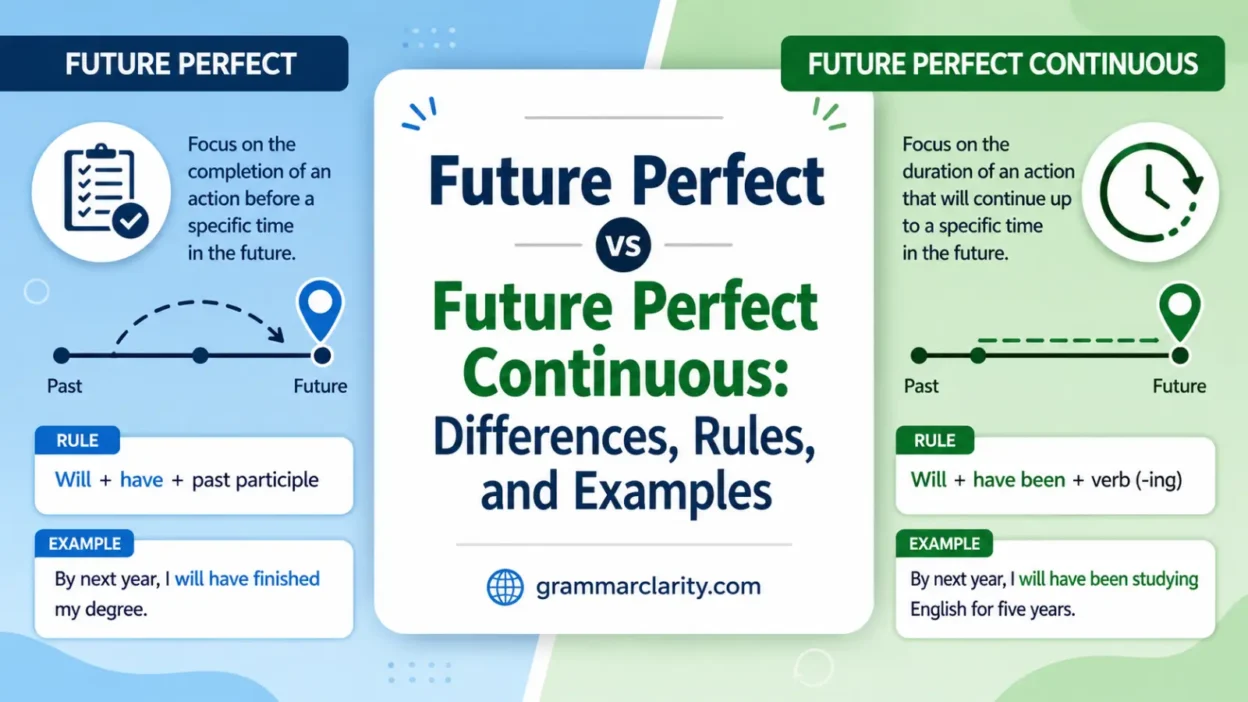
Future perfect focuses on completion.
Future perfect continuous focuses on duration.
That single idea explains most usage differences.
Compare these examples:
By Friday, I will have finished the website redesign.
This sentence focuses on the result. The work is complete.
By Friday, I will have been working on the website redesign for two weeks.
This sentence focuses on the time spent doing the work.
Understanding this difference makes it much easier to choose the right form in speaking and writing.
Quick Answer
Use future perfect when an action will be completed before a future point.
Structure:
will + have + past participle
Example:
By next month, they will have opened the new store.
Use future perfect continuous when emphasizing how long an action will continue up to a future point.
Structure:
will + have + been + verb-ing
Example:
By next month, they will have been operating the store for a year.
Quick memory tip:
- Completed action → future perfect
- Time spent doing something → future perfect continuous
Why People Confuse Them
There are several reasons people confuse these two forms.
Both Use Similar Structures
Look at the patterns:
Future perfect:
will have finished
Future perfect continuous:
will have been finishing
Only one word changes.
Because the forms are close, learners often switch them accidentally.
Both Talk About Future Time
Neither tense describes the present or past.
Both look ahead.
Examples:
By noon, I will have sent the email.
By noon, I will have been working for five hours.
Both sentences point toward the future.
Both Use Time Expressions
The same time markers often appear with both forms.
Examples include:
- by tomorrow
- by next week
- by the time
- before
- in two years
This overlap creates confusion.
Both Connect Two Future Moments
Each tense links an action to another future point.
But they focus on different details.
Future perfect asks:
Will it be finished?
Future perfect continuous asks:
How long will it have continued?
Key Differences At A Glance
| Feature | Future Perfect | Future Perfect Continuous |
|---|---|---|
| Main focus | Completion | Duration |
| Structure | will have + past participle | will have been + verb-ing |
| Purpose | Shows finished action | Shows ongoing action |
| Time emphasis | Result | Length of activity |
| Example | will have completed | will have been completing |
Another way to remember:
Result matters → future perfect
Process matters → future perfect continuous
Meaning and Usage Difference
Understanding the meaning difference is the key to using these forms correctly.
Future Perfect Meaning
Future perfect shows that an action will already be complete before another future moment.
Structure:
Subject + will + have + past participle
Example:
By next summer, I will have graduated.
The graduation is complete.
Another example:
The team will have launched the product by October.
The launch is finished before October arrives.
Future perfect answers questions like:
- What will already be done?
- What will be finished?
- What result will exist?
Examples:
By tonight, we will have cleaned the garage.
She will have submitted the report before the meeting.
The movie will have ended by then.
The focus stays on completion.
Future Perfect Continuous Meaning
Future perfect continuous emphasizes duration up to a future point.
Structure:
Subject + will + have + been + verb-ing
Example:
By next summer, I will have been studying engineering for four years.
The focus is not graduation.
The focus is the length of studying.
More examples:
By October, the company will have been operating for ten years.
By noon, we will have been driving for six hours.
She will have been teaching since early morning.
This form answers questions such as:
- How long?
- For how much time?
- How long will the action continue?
Compare Side by Side
Future perfect:
By July, Alex will have written the book.
Focus: completed book.
Future perfect continuous:
By July, Alex will have been writing the book for eight months.
Focus: time spent writing.
Both sentences can be true at the same time.
But the meaning changes.
Time Expressions Often Used
Future perfect commonly appears with:
- by
- before
- by the time
- already
Examples:
We will have arrived by noon.
She will have left before sunset.
Future perfect continuous often uses:
- for
- since
- all day
- all week
Examples:
They will have been traveling for weeks.
He will have been practicing since January.
Tone, Context, and Formality
Both forms are standard in American English.
Neither is incorrect or outdated.
However, they do not appear equally in daily conversation.
Future Perfect Is More Common
Future perfect appears more often in everyday speech.
Examples:
I’ll have finished by then.
We’ll have paid everything before moving.
They’ll have arrived already.
These sound natural and common.
Future Perfect Continuous Is More Specific
Future perfect continuous appears when speakers want to stress duration.
Examples:
By next month, I’ll have been working here for five years.
She’ll have been training all season.
It is slightly less common because people do not always need to emphasize duration.
Professional Contexts
Future perfect works well in schedules and project planning.
Examples:
The construction team will have completed Phase One by December.
The software update will have launched before year-end.
Future perfect continuous often appears in reports and long-term discussions.
Examples:
By 2027, the company will have been operating for twenty years.
Researchers will have been studying the issue for a decade.
Spoken English Preference
In everyday conversation, many speakers choose simpler wording.
Instead of:
I will have been working here for five years.
People sometimes say:
Next year makes five years here.
But the grammatical form remains correct and useful.
Which One Should You Use?
Choosing between these forms becomes easy when you ask one question:
Do I care about completion or duration?
If completion matters, choose future perfect.
If duration matters, choose future perfect continuous.
| Context | Best Choice | Why |
|---|---|---|
| Finished project | Future perfect | Shows result |
| Time spent working | Future perfect continuous | Shows duration |
| Completed task | Future perfect | Action ends |
| Long activity | Future perfect continuous | Action continues |
Use Future Perfect When Result Matters
Examples:
By Friday, we will have finished the redesign.
By noon, she will have answered all emails.
The workers will have repaired the road.
Each sentence highlights the completed result.
Use Future Perfect Continuous When Time Matters
Examples:
By Friday, we will have been redesigning the site for three weeks.
By noon, she will have been answering emails all morning.
The workers will have been repairing the road for days.
These focus on time and activity.
Simple Decision Rule
Ask:
What matters more?
The finished action?
Choose future perfect.
The length of the activity?
Choose future perfect continuous.
When One Choice Sounds Wrong
Sometimes using the wrong form creates awkward sentences.
Completion Verbs Often Prefer Future Perfect
Example:
Correct:
By tonight, I will have finished dinner.
Less natural:
By tonight, I will have been finishing dinner.
“Finish” already means completion.
Adding continuous structure feels strange.
Duration Actions Prefer Future Perfect Continuous
Correct:
By June, she will have been living here for ten years.
Possible but different:
By June, she will have lived here for ten years.
The second sentence works.
But it sounds more factual.
The first highlights the ongoing experience.
Short Actions Rarely Need Future Perfect Continuous
Less natural:
By noon, he will have been opening the package.
Better:
By noon, he will have opened the package.
Opening usually happens quickly.
Duration is unnecessary.
State Verbs Can Be Difficult
Some verbs rarely use continuous forms.
Examples:
- know
- believe
- understand
- own
Incorrect:
By next year, I will have been knowing her for ten years.
Correct:
By next year, I will have known her for ten years.
Common Mistakes (and Quick Fixes)
Mistake 1: Using Verb-ing in Future Perfect
Wrong:
I will have finishing the project.
Correct:
I will have finished the project.
Remember:
Future perfect uses the past participle.
Mistake 2: Forgetting “Been”
Wrong:
I will have working here for years.
Correct:
I will have been working here for years.
Future perfect continuous always includes been.
Mistake 3: Using Completion Verbs Incorrectly
Wrong:
I will have been completed the report.
Correct:
I will have completed the report.
Completion actions usually need future perfect.
Mistake 4: Ignoring Duration Signals
Wrong:
By next year, I will have worked here for five years.
Better:
By next year, I will have been working here for five years.
“Five years” suggests duration.
Mistake 5: Confusing Result and Process
Result:
They will have built the house.
Process:
They will have been building the house.
The meaning changes.
Everyday Examples
Workplace Examples
Future perfect:
By Monday, the team will have finished testing.
The manager will have approved the budget.
We will have updated the website.
Future perfect continuous:
By Monday, the team will have been testing for two weeks.
The manager will have been reviewing applications all morning.
We will have been updating the site for months.
School Examples
Future perfect:
By graduation, she will have completed her degree.
The students will have submitted their projects.
Future perfect continuous:
By graduation, she will have been studying biology for four years.
The students will have been preparing all semester.
Travel Examples
Future perfect:
By sunset, we will have reached Chicago.
They will have checked into the hotel.
Future perfect continuous:
By sunset, we will have been driving for nine hours.
They will have been traveling for days.
Daily Life Examples
Future perfect:
I’ll have cleaned the kitchen before guests arrive.
Dad will have cooked dinner.
Future perfect continuous:
I’ll have been cleaning all morning.
Dad will have been cooking since noon.
Dictionary-Style Word Details
Verb
Future perfect:
Grammar tense used to show a completed future action.
Pattern:
will + have + past participle
Example:
She will have finished.
Future perfect continuous:
Grammar tense used to show duration up to a future point.
Pattern:
will + have + been + verb-ing
Example:
She will have been working.
Noun
Future perfect:
Used as the name of a grammar tense.
Example:
Future perfect is common in project planning.
Future perfect continuous:
Used as the name of a grammar tense.
Example:
Future perfect continuous emphasizes duration.
Synonyms
Future perfect:
Closest plain alternatives:
- completed future action
- finished future event
Future perfect continuous:
Closest plain alternatives:
- ongoing future duration
- continuing future action
No exact antonyms clearly apply.
Example Sentences
Future perfect:
By Friday, we will have finished the proposal.
The guests will have arrived.
She will have completed the course.
Future perfect continuous:
By Friday, we will have been preparing for weeks.
The guests will have been traveling all day.
She will have been studying for months.
Word History
Future perfect:
Traditional grammar term combining the ideas of future time and completed action.
Future perfect continuous:
Traditional grammar term combining future time, completion viewpoint, and ongoing action.
Specific origin dates are not necessary for understanding usage.
Phrases Containing
Future perfect:
- by tomorrow
- before noon
- by next year
- by the time
Future perfect continuous:
- for years
- all week
- since January
- for hours
Conclusion
Future perfect and future perfect continuous may look similar, but their jobs are different.
Use future perfect when the action will be completed before a future point.
Example:
By Friday, I will have finished the report.
Use future perfect continuous when emphasizing how long something continues.
Example:
By Friday, I will have been working on the report for two weeks.
Final shortcut:
Finished result = future perfect
Time spent doing = future perfect continuous