Less vs fewer is a common word-choice problem because the basic rule is easy, but real usage has a few exceptions.
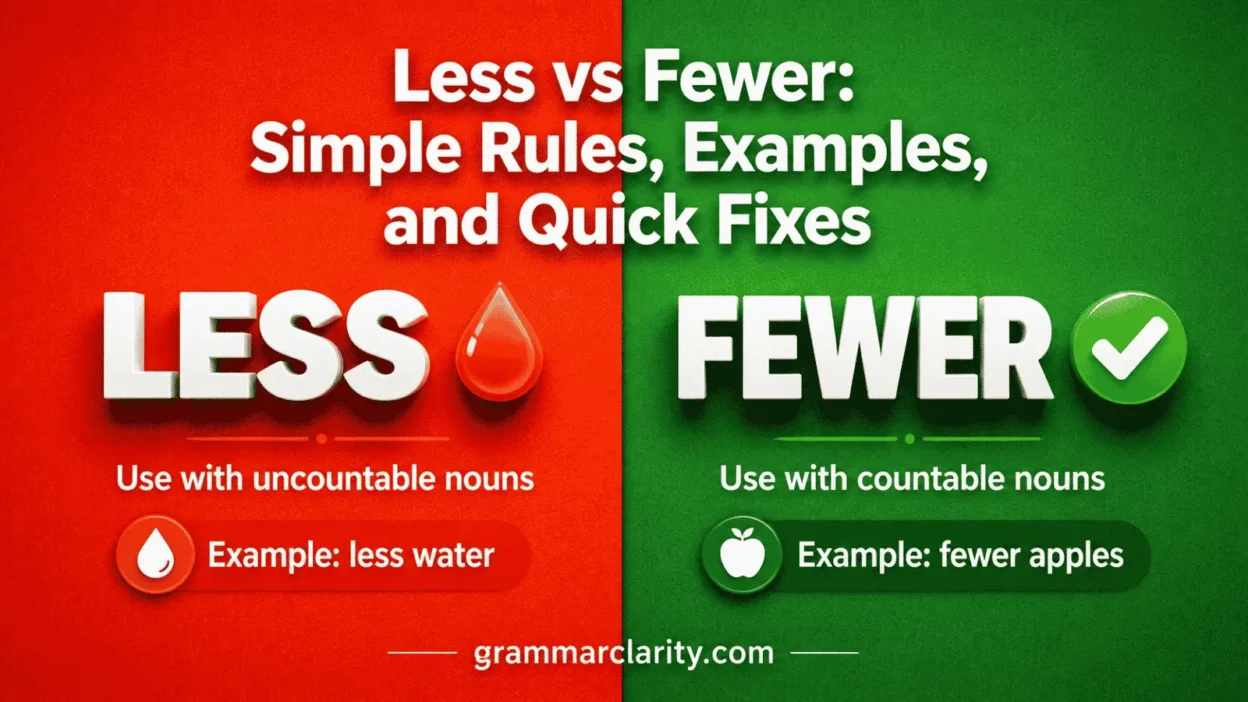
Use fewer when you mean a smaller number of individual things you can count. Use less when you mean a smaller amount, degree, or quantity that is not naturally counted one by one.
That means fewer emails, fewer mistakes, and fewer cars, but less time, less stress, and less water.
The tricky part is that less is also common and accepted in some expressions involving time, money, distance, weight, percentages, and measurements.
Quick Answer
Use fewer with plural countable nouns.
Use less with uncountable nouns, general amounts, and many measured quantities.
Correct examples:
- We had fewer meetings this week.
- She made fewer errors after revising the report.
- I need less coffee today.
- The project took less time than expected.
- The package weighs less than five pounds.
A simple test helps: if you can put a number directly before the noun, fewer is usually the safer choice. If you are talking about an amount rather than separate items, use less.
Why People Confuse Them
People confuse less and fewer because both words mean “not as much” or “not as many.”
In everyday speech, many people use less for both countable and uncountable things. You will hear phrases like “less people,” “less problems,” and “10 items or less.” Those phrases are common, but in polished writing, fewer people, fewer problems, and 10 items or fewer are usually stronger choices.
Another reason is that not all countable nouns behave the same way. We often say less than five miles, less than three hours, and less than $20, even though miles, hours, and dollars can be counted. In those cases, the phrase usually feels like one measured amount, not a set of separate items.
Key Differences At A Glance
| Context | Best Choice | Why |
|---|---|---|
| Individual items you can count | Fewer | The noun refers to separate units |
| Plural countable nouns | Fewer | The focus is number |
| Uncountable nouns | Less | The focus is amount or quantity |
| Time as a measured amount | Less | The phrase works as one span |
| Money as a total amount | Less | The phrase works as one sum |
| Distance or weight | Less | The phrase works as a measurement |
| Formal edited writing | Usually fewer for countable nouns | It avoids distracting careful readers |
| Casual speech | Less is often heard | It may sound natural, though not always preferred |
Meaning and Usage Difference
Fewer means “a smaller number of.” It points to things you can count separately.
Examples:
- fewer students
- fewer applications
- fewer stores
- fewer complaints
- fewer distractions
Less means “a smaller amount of.” It points to quantity, degree, extent, or mass.
Examples:
- less money
- less time
- less patience
- less traffic
- less information
Here is the practical difference:
- Fewer cars means a smaller number of cars.
- Less traffic means a smaller amount of traffic overall.
Cars are countable. Traffic is treated as a general amount.
The same idea applies here:
- Fewer assignments means not as many separate assignments.
- Less homework means not as much homework overall.
Tone, Context, and Formality
In formal US English, fewer is the cleaner choice with plural countable nouns.
Use it in essays, reports, business writing, journalism, academic work, and professional editing when the noun clearly names separate items.
Better formal choices:
- fewer employees
- fewer tickets
- fewer delays
- fewer options
- fewer questions
Less is natural with abstract or uncountable ideas:
- less pressure
- less confusion
- less interest
- less support
- less noise
In casual speech, less often appears where traditional editing would prefer fewer. That does not mean every casual use is unclear. It does mean that in writing, especially writing meant to sound careful, fewer is less likely to distract the reader when the noun is countable.
Which One Should You Use?
Use fewer when the noun is plural and countable.
- fewer books
- fewer people
- fewer reasons
- fewer messages
- fewer meetings
Use less when the noun is singular, abstract, uncountable, or measured as a total amount.
- less food
- less work
- less energy
- less room
- less than 30 minutes
A quick way to decide:
- If you mean “not as many,” choose fewer.
- If you mean “not as much,” choose less.
Compact comparison:
- Less: amount, degree, mass, measurement, total quantity.
- Fewer: number, separate items, plural countable nouns.
When One Choice Sounds Wrong
Less sounds wrong to many careful readers when it appears before a clearly countable plural noun.
Weak:
- less mistakes
- less people
- less cars
- less reasons
Better:
- fewer mistakes
- fewer people
- fewer cars
- fewer reasons
Fewer sounds wrong when the noun is uncountable or abstract.
Weak:
- fewer water
- fewer furniture
- fewer advice
- fewer patience
Better:
- less water
- less furniture
- less advice
- less patience
The phrase may also sound awkward when the idea is a total measurement rather than individual units.
Natural:
- less than five miles
- less than two hours
- less than $50
- less than 10 percent
These expressions are usually treated as amounts, not as separate countable objects.
Common Mistakes (and Quick Fixes)
One common mistake is using less with people.
Instead of:
- There were less people at the event this year.
Write:
- There were fewer people at the event this year.
Another mistake is using fewer with abstract nouns.
Instead of:
- I have fewer interest in that option now.
Write:
- I have less interest in that option now.
Writers also overcorrect by forcing fewer into measurement phrases where less sounds more natural.
Awkward:
- The drive took fewer than three hours.
Natural:
- The drive took less than three hours.
Another common problem is treating collective or general nouns as if they were separate items.
Compare:
- We need fewer cars downtown.
- We need less traffic downtown.
Both can be correct, but they do not mean the same thing. The first counts cars. The second describes the overall amount of traffic.
Everyday Examples
Use fewer when the noun names separate things:
- The office scheduled fewer meetings this month.
- The new checkout process created fewer delays.
- I received fewer emails after unsubscribing.
- The store had fewer open registers on Sunday.
- The team made fewer changes before launch.
Use less when the noun names an amount or general condition:
- I need less noise when I’m working.
- The revised plan takes less time.
- She showed less hesitation during the interview.
- There is less traffic after 9 a.m.
- This version uses less storage on your phone.
Some sentences can change meaning depending on the word:
- We need fewer lights in this room.
- We need less light in this room.
The first means the room has too many lamps or light fixtures. The second means the room is too bright.
Another example:
- The company wants fewer reports.
- The company wants less reporting.
The first means a smaller number of reports. The second means a smaller amount of reporting work.
Dictionary-Style Word Details
Verb
Neither less nor fewer is normally used as a verb in modern standard English.
Do not write sentences such as:
- The policy will fewer the number of claims.
- The change will less the cost.
Use reduce, lower, decrease, or cut instead.
Better:
- The policy will reduce the number of claims.
- The change will lower the cost.
Noun
Less and fewer are not usually treated as ordinary nouns. They more often work as determiners, pronouns, adjectives, or adverbs, depending on the sentence.
Examples:
- I expected more, but received less.
- Fewer than ten people replied.
- The less you rush, the fewer errors you make.
In practical writing, focus less on the label and more on what follows the word: a countable number or an overall amount.
Synonyms
For less, useful alternatives include:
- smaller amount
- lower amount
- reduced
- not as much
- lower degree
For fewer, useful alternatives include:
- smaller number
- not as many
- reduced number of
- a lower count of
Choose the synonym that fits the noun. “Reduced number of complaints” works. “Reduced amount of complaints” sounds less precise because complaints are countable.
Example Sentences
- We need fewer steps in the sign-up process.
- The app now uses less battery power.
- Fewer students missed class after the schedule changed.
- I have less patience for unclear instructions.
- The report has fewer charts but less clutter.
- Less spending does not always mean fewer purchases.
- Fewer people attended, so there was less noise.
- The recipe needs less salt, not fewer ingredients.
Word History
For modern writers, the most useful history is simple: less has long been used broadly, but fewer became the preferred choice when the meaning is “a smaller number of countable things.”
That preference remains important in edited English because it gives writers a clear distinction:
- less for amount
- fewer for number
The rule is useful, but it is not absolute in every measurement phrase.
Phrases Containing
Common phrases with less:
- less than
- less likely
- less often
- less expensive
- less time
- less effort
- more or less
- no less than
Common phrases with fewer:
- fewer than
- fewer people
- fewer options
- fewer problems
- fewer mistakes
- fewer chances
- fewer restrictions
- fewer and fewer
Use fewer than when the phrase introduces a countable plural noun:
- fewer than 20 applicants
- fewer than five questions
- fewer than three errors
Use less than when the phrase introduces a measurement, amount, or total:
- less than $100
- less than two hours
- less than a mile
- less than 10 percent
Conclusion
The safest rule for less vs fewer is this: use fewer for things you can count one by one, and use less for amounts, degrees, and quantities.
Write fewer mistakes, fewer people, and fewer choices.
Write less time, less stress, and less water.
For measurements like money, time, distance, weight, and percentages, less often sounds natural because the phrase works as a total amount. When the noun is clearly a plural countable item, though, fewer is the better choice in polished US English.