English learners and even native speakers often confuse their and there. Though they sound alike, each word serves a distinct role in writing and conversation. Mastering their proper use can make your communication clearer and more professional.
Quick Answer
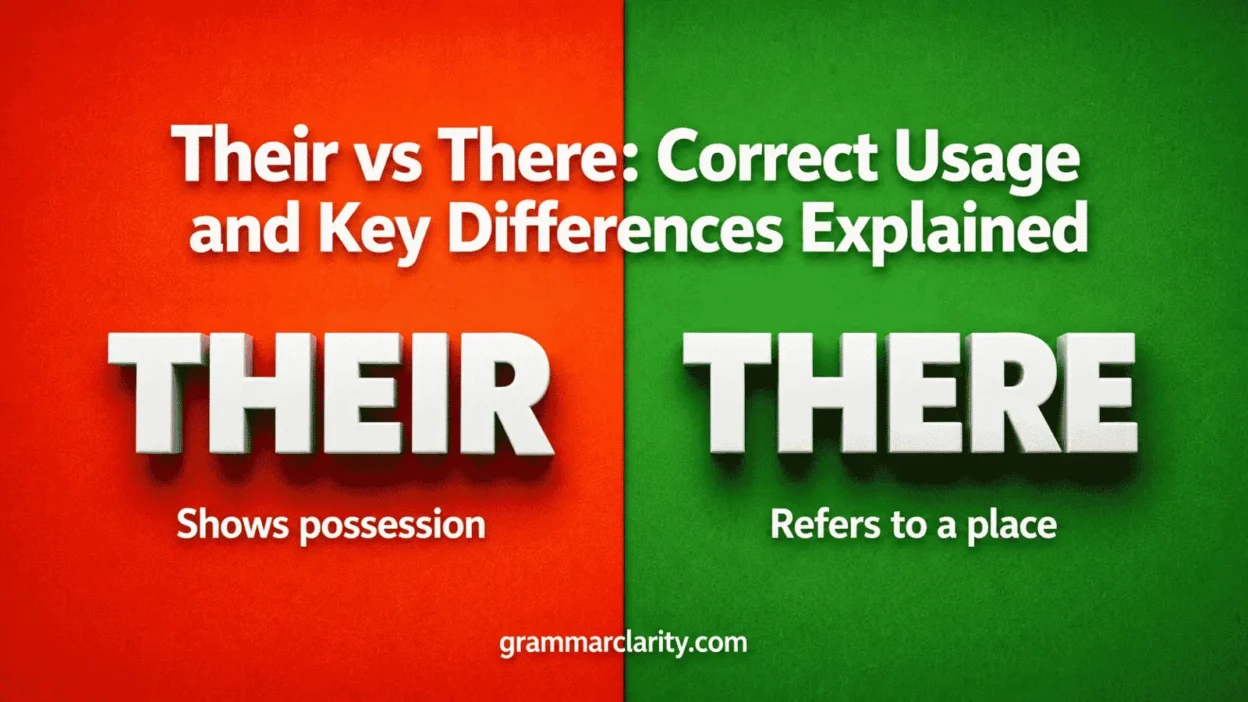
- Their = possessive pronoun, shows ownership.
- There = adverb or pronoun indicating place, existence, or direction.
Use their when you are talking about something that belongs to someone.
Use there when pointing out a location or existence.
Why People Confuse Them
The confusion arises because both words are pronounced the same way. Without visual cues in speech, listeners rely on context, which can sometimes be misleading. Spelling mistakes in writing often occur due to this similarity.
Key Differences At A Glance
| Context | Best Choice | Why |
|---|---|---|
| Ownership | Their | Shows something belongs to someone |
| Location | There | Indicates a place or position |
| Existence | There | Introduces or points out something |
Meaning and Usage Difference
- Their: Always possessive. Example: Their car is parked outside.
- There: Can indicate:
- Place: The keys are over there.
- Existence: There is a meeting at 3 PM.
- Introduction: There seems to be a mistake.
Tone, Context, and Formality
Both words are neutral in tone and suitable for formal or informal writing. Misusing them can, however, make writing appear careless. Their is strictly tied to ownership, while there is flexible but must match grammatical context.
Which One Should You Use?
- Use their to describe possessions or associations with people or entities.
- Use there to indicate locations, existence, or introduce ideas.
When One Choice Sounds Wrong
- There dog is friendly → incorrect (their dog is friendly).
- I left their on the table → incorrect (I left there on the table).
- Always check whether the sentence requires possession or location/existence.
Common Mistakes (and Quick Fixes)
- Mistaking their for there in location sentences:
Incorrect: Their is a park nearby.
Correct: There is a park nearby. - Using there for ownership:
Incorrect: There house is beautiful.
Correct: Their house is beautiful. - Combining both incorrectly in compound sentences:
Incorrect: Their over there enjoying the view.
Correct: They are over there enjoying the view.
Everyday Examples
- Their:
- Their ideas were innovative and practical.
- I met their parents at the event.
- There:
- There is a new café on Main Street.
- Put the books over there on the shelf.
- There seems to be an issue with the printer.
Dictionary-Style Word Details
Verb
- Neither their nor there functions as a verb.
Noun
- Neither functions as a noun.
Synonyms
- Their: belonging to them, of them.
- There: in that place, at that point, existent.
Example Sentences
- Their: Their team won the championship.
- There: There was a loud noise outside.
Word History
- Their: Middle English, from Old Norse þeirra, possessive of they.
- There: Old English þǣr, indicating place or location.
Phrases Containing
- Their: Their own, in their care, for their sake.
- There: Over there, there is/are, thereabouts.
Conclusion
Understanding the distinction between their and there is essential for clear, correct writing. Remember: their = possession, there = location/existence. Practice with everyday sentences, and the correct choice will become second nature.