In vs on is a common English question because both words can describe time, place, position, media, transportation, and everyday situations.
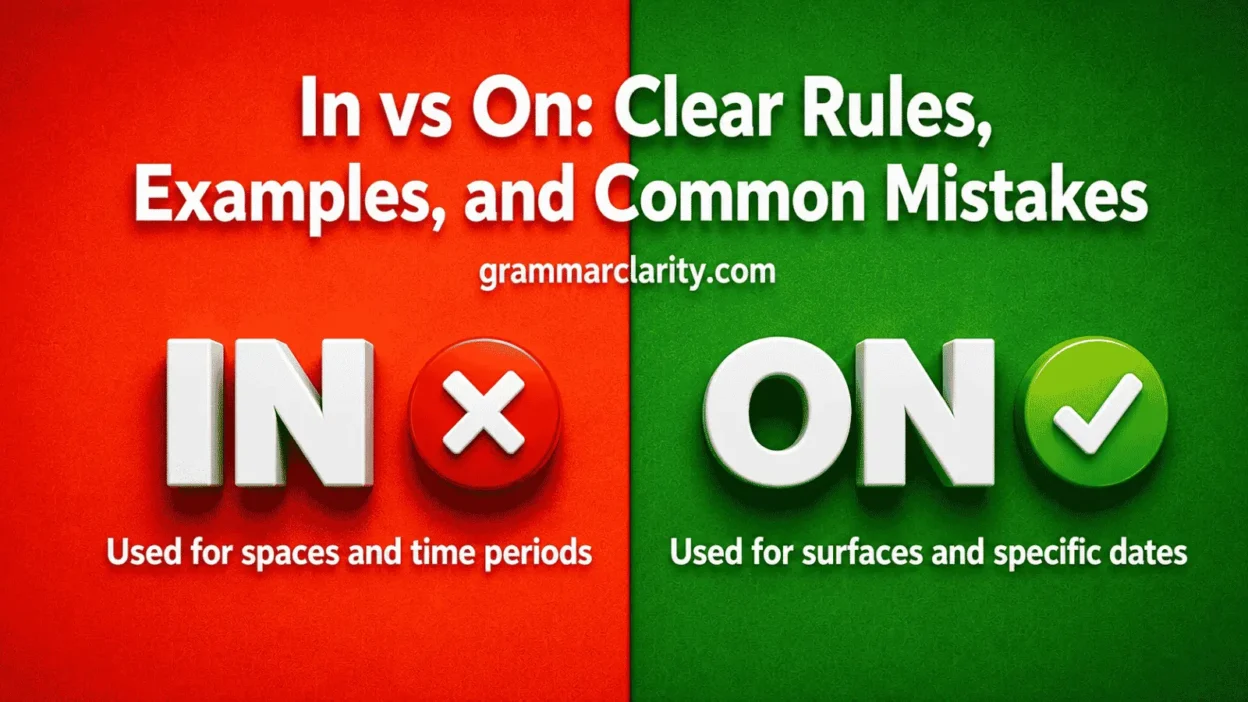
The simple difference is this: use “in” when something is inside, within, or part of a larger space or period. Use “on” when something is touching a surface, attached to something, scheduled for a specific day or date, or appearing on a screen or platform.
That rule works most of the time, but English has many fixed expressions. You say in a car but on a bus. You say in a book but on a website. The best choice depends on the relationship you mean.
Quick Answer
Use in for enclosed spaces, larger time periods, cities, states, countries, rooms, containers, and written content.
Use on for surfaces, specific days and dates, streets, screens, devices, platforms, and many forms of public transportation.
Examples:
- She is in the kitchen.
- The keys are on the counter.
- We met in March.
- The meeting is on Friday.
- I read it in the report.
- I saw it on the website.
Why People Confuse Them
People confuse in and on because both can answer “where?” or “when?” They are also short, common prepositions, so native speakers use them automatically without always explaining the logic.
The confusion gets worse because some nouns can take either word with a change in meaning.
For example:
- The papers are in the desk.
The papers are inside a drawer or enclosed part of the desk. - The papers are on the desk.
The papers are resting on the surface.
Both sentences are correct, but they do not mean the same thing.
Key Differences At A Glance
| Context | Best Choice | Why |
|---|---|---|
| Inside a room, box, city, or country | in | The thing is within a space or area. |
| Resting against a surface | on | The thing touches or sits on top of a surface. |
| Months, years, seasons, or long periods | in | The time is a broad period. |
| Days and exact dates | on | The time is a specific calendar day. |
| Books, reports, articles, and documents | in | The information is part of the written content. |
| Websites, screens, apps, and platforms | on | The information appears on a surface, screen, or platform. |
| Cars and taxis | in | The person is inside a smaller enclosed vehicle. |
| Buses, trains, planes, and ships | on | The person is aboard a larger public vehicle. |
Meaning and Usage Difference
In usually points to enclosure, inclusion, or being within limits.
Use in when the noun feels like a container, area, group, period, or body of content.
Examples:
- in the drawer
- in Texas
- in the office
- in the summer
- in the contract
- in the photo
- in the first chapter
On usually points to contact, position, attachment, display, or a specific scheduled point.
Use on when the noun feels like a surface, line, day, date, screen, device, or public route.
Examples:
- on the table
- on Main Street
- on Monday
- on July 4
- on the phone
- on the website
- on the train
Compact comparison:
- In = inside, within, during a broader period, part of written content.
- On = touching a surface, displayed, attached, aboard, or scheduled for a day or date.
Tone, Context, and Formality
Both in and on are neutral. Neither is more formal by itself.
The difference is not tone. The difference is meaning.
In formal writing, choose the preposition that makes the relationship precise:
- The policy appears in the employee handbook.
- The notice appears on the company website.
- The deadline falls in the second quarter.
- The deadline falls on June 30.
In casual speech, some expressions are fixed by habit:
- I’m on my phone.
- She’s in the car.
- We’re on vacation.
- He’s in a meeting.
These are not random choices. They reflect common English patterns that readers expect.
Which One Should You Use?
Choose in when you mean “inside” or “within.”
- The receipt is in my bag.
- She lives in Chicago.
- The answer is in the instructions.
- We finished the project in April.
Choose on when you mean “on top of,” “attached to,” “displayed by,” or “scheduled for.”
- The receipt is on the table.
- The sign is on the door.
- The update is on the dashboard.
- We finished the project on April 12.
For time, remember this pattern:
Use in for broad time periods:
- in 2026
- in May
- in the morning
- in the past
- in a few weeks
Use on for specific days and dates:
- on Tuesday
- on May 5
- on Thanksgiving
- on my birthday
- on the weekend
When One Choice Sounds Wrong
Some choices sound wrong because they break a fixed English pattern.
Say:
- in a car, not usually on a car
- on a bus, not usually in a bus
- in the news article, not on the news article
- on the website, not in the website
- in New York, not on New York
- on the floor, not in the floor
Still, context can change the answer.
A person can be in a chair if the chair surrounds the body, especially an armchair. A person can be on a chair if the focus is the surface or seat.
A picture can be in a book because it is part of the book’s content. A sticker can be on a book because it is attached to the cover.
Common Mistakes (and Quick Fixes)
Mistake: “I saw it in the website.”
Fix: “I saw it on the website.”
Use on for websites, screens, pages online, and platforms.
Mistake: “The meeting is in Monday.”
Fix: “The meeting is on Monday.”
Use on for days.
Mistake: “She lives on California.”
Fix: “She lives in California.”
Use in for states, cities, countries, and regions.
Mistake: “The file is on the folder.”
Fix: “The file is in the folder.”
Use in when the folder contains the file.
Mistake: “The quote is on the report.”
Fix: “The quote is in the report.”
Use in when the quote is part of the document’s content.
Everyday Examples
Use in when something is inside a place:
- My wallet is in my backpack.
- The kids are in the living room.
- There is cold water in the fridge.
Use on when something is on a surface:
- Your coffee is on the counter.
- The painting is on the wall.
- I left a note on your desk.
Use in for broader time:
- We moved in 2025.
- She usually runs in the morning.
- The store opened in November.
Use on for exact days and dates:
- We moved on March 14.
- The event starts on Saturday.
- Her appointment is on the first of the month.
Use in for written content:
- The rule is explained in the guide.
- I found the answer in the article.
- The chart appears in the appendix.
Use on for screens and platforms:
- The video is on the homepage.
- The reminder popped up on my phone.
- The post is on the company page.
Dictionary-Style Word Details
Verb
In and on are not verbs in this comparison. They are mainly used as prepositions.
A preposition connects a noun or pronoun to another part of the sentence and shows a relationship such as place, time, position, or direction.
Noun
In and on are not normally nouns in everyday grammar use.
They can appear as words being discussed, as in:
- “In” is the better choice here.
- “On” works better with days and dates.
In those examples, the words are being named, not used in their usual sentence function.
Synonyms
Because in and on are prepositions, they do not have perfect one-word synonyms in every context.
Possible nearby meanings for in include:
- inside
- within
- during
- into
- among
Possible nearby meanings for on include:
- atop
- upon
- attached to
- aboard
- against
These words are not always interchangeable. For example, inside the box can replace in the box, but inside Monday cannot replace on Monday.
Example Sentences
- The documents are in the folder.
- The documents are on the desk.
- She lives in Boston.
- She works on Beacon Street.
- The class begins in September.
- The class begins on September 3.
- The answer is in the manual.
- The answer is on the website.
- He is in a taxi.
- He is on a train.
Word History
In and on are old, basic English prepositions. Their core meanings have long been connected to location and relationship.
In modern English, in still often suggests being within limits or inside something. On still often suggests contact with a surface, position, attachment, or a scheduled point in time.
The safest approach is not to memorize a long history. It is to learn the current patterns that guide everyday American English.
Phrases Containing
Common phrases with in:
- in a hurry
- in trouble
- in public
- in private
- in charge
- in person
- in advance
- in the meantime
- in the long run
- in good condition
Common phrases with on:
- on time
- on purpose
- on sale
- on vacation
- on duty
- on hold
- on the way
- on the other hand
- on schedule
- on good terms
Many of these are fixed expressions. Changing the preposition may make the phrase sound unnatural or change the meaning.
Conclusion
The difference between in vs on comes down to relationship.
Use in when something is inside, within, included, or part of a larger space, time period, group, or document.
Use on when something touches a surface, appears on a screen or platform, is attached to something, happens on a specific day or date, or involves being aboard certain forms of transportation.
When you are unsure, ask what relationship you mean: inside it, or on its surface? within a broad time period, or on a specific day? part of a document, or displayed on a platform? That question usually leads to the right choice.