The choice between a vs an is simple once you stop looking at the first letter and start listening to the first sound.
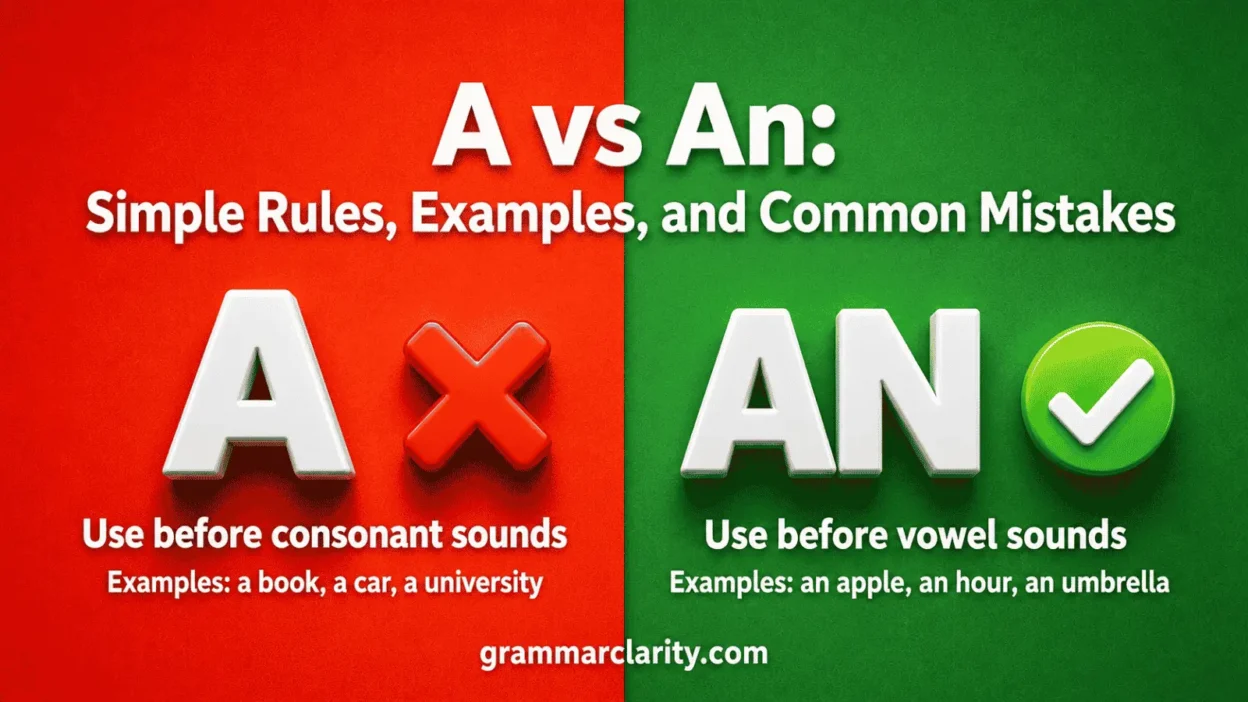
Use a before a consonant sound. Use an before a vowel sound.
That means the correct choice is not always based on whether the next word begins with a written consonant or vowel. It depends on how the word sounds when spoken.
You write a university because university begins with a “yoo” sound. You write an hour because the h is silent and the word begins with an “ow” sound.
Quick Answer
Use a when the next word begins with a consonant sound:
- a book
- a car
- a useful tool
- a one-time offer
- a historic moment
Use an when the next word begins with a vowel sound:
- an apple
- an issue
- an honest answer
- an hour
- an MRI
Compact comparison:
- a = before a consonant sound
- an = before a vowel sound
- The sound matters more than the spelling
- Say the next word out loud if you are unsure
Why People Confuse Them
People often learn the shortcut “use a before consonants and an before vowels.” That shortcut works in many everyday cases, but it is incomplete.
It explains a dog and an orange, but it does not explain a university, an honor, a European trip, or an FBI agent.
The confusion happens because English spelling and English pronunciation do not always match. Some vowel letters begin with consonant sounds. Some consonant letters begin with vowel sounds.
So the real question is not “What letter comes next?” The real question is “What sound comes next?”
Key Differences At A Glance
| Context | Best Choice | Why |
|---|---|---|
| Before a consonant sound | a | The next sound is not a vowel sound |
| Before a vowel sound | an | The next sound begins open and vowel-like |
| Before silent h | an | The first pronounced sound is a vowel sound |
| Before pronounced h | a | The first pronounced sound is consonant-like |
| Before “you” sound | a | The sound begins like y |
| Before abbreviations said letter by letter | Depends | Use the sound of the first spoken letter |
Meaning and Usage Difference
A and an have the same meaning. Both are indefinite articles.
They refer to one nonspecific person, place, thing, or idea.
For example:
- I need a pen.
- She asked an important question.
In both sentences, the speaker is not naming one specific item known to the reader. The article simply introduces one general thing.
The difference is pronunciation. English uses an before vowel sounds because it makes speech smoother. Saying an apple is easier and more natural than saying a apple. Saying a book is easier and more natural than saying an book.
Tone, Context, and Formality
The choice between a and an is not about tone. One is not more formal than the other.
Both are standard in casual, professional, academic, and edited English. The correct choice depends on the sound that follows.
In formal writing, the same sound-based rule applies:
- a research paper
- an academic journal
- a federal policy
- an environmental report
In everyday writing, the rule is the same:
- a coffee
- an iced coffee
- a great idea
- an easy fix
The only area where style can vary is with words that begin with h, especially when pronunciation differs by speaker or region. In modern American English, if the h is pronounced, a is usually the natural choice: a historic event, a hotel, a hypothesis. If the h is silent, use an: an hour, an honest mistake, an heir.
Which One Should You Use?
Choose a or an by saying the next word or abbreviation out loud.
Use a if the next sound is consonant-like:
- a user
- a union
- a European city
- a one-bedroom apartment
- a NASA scientist
Use an if the next sound is vowel-like:
- an umbrella
- an office
- an X-ray
- an MBA
- an NFL game
Abbreviations are especially important. Do not decide by the first written letter alone. Decide by how the abbreviation is spoken.
You write an FBI investigation because F is pronounced “eff,” which begins with a vowel sound. You write a URL if you pronounce it “you-are-ell,” because the first sound is like y.
When One Choice Sounds Wrong
The wrong choice often sounds awkward because English speakers expect the article to flow into the next word.
These sound unnatural:
- an university
- a apple
- an one-time fee
- a honest answer
- a MRI
The corrected versions are:
- a university
- an apple
- a one-time fee
- an honest answer
- an MRI
The mistake usually comes from trusting the first letter too much. A word can begin with u and still take a. A word can begin with h and still take an. A word can begin with m and still take an when the letter is spoken as “em.”
Common Mistakes (and Quick Fixes)
One common mistake is writing an before every word that starts with a vowel letter.
Incorrect: She works at an university.
Correct: She works at a university.
The word university begins with a “yoo” sound, so a is correct.
Another common mistake is writing a before silent h words.
Incorrect: It was a honest mistake.
Correct: It was an honest mistake.
The h in honest is silent, so the first sound is a vowel sound.
A third mistake is treating abbreviations like normal words.
Incorrect: He gave a MRI report to the doctor.
Correct: He gave an MRI report to the doctor.
The letter M is pronounced “em,” which begins with a vowel sound.
Everyday Examples
Here are natural examples of a:
- I bought a new laptop.
- She found a useful shortcut.
- We stayed in a hotel near the airport.
- He made a one-time payment.
- They adopted a dog from the shelter.
Here are natural examples of an:
- I ate an apple before work.
- She gave an honest answer.
- We waited for an hour.
- He sent an email this morning.
- They watched an NBA playoff game.
Mixed examples make the rule clearer:
- It was a unique opportunity.
- It was an unusual opportunity.
- She is a USC graduate.
- She is an NYU graduate.
- He had a minor injury.
- He needed an MRI.
Dictionary-Style Word Details
Verb
A and an are not verbs. They do not show action, tense, or state of being.
Noun
A and an are not nouns. They do not name a person, place, thing, or idea. They are indefinite articles used before singular count nouns.
Synonyms
There is no exact synonym for a or an in normal grammar. In meaning, both can suggest “one” or “any single,” depending on the sentence.
Examples:
- I need a chair.
- I need one chair.
The sentences are close, but not always identical in tone. One puts more emphasis on number.
Example Sentences
- She brought a notebook to the meeting.
- He asked an excellent question.
- We need a clear plan.
- They made an early reservation.
- I saw a one-act play downtown.
- She completed an MBA program.
Word History
A and an are closely related forms of the same indefinite article. Modern English keeps both forms because they help speech flow more naturally before different sounds.
Today, the practical rule is pronunciation-based: a before consonant sounds and an before vowel sounds.
Phrases Containing
Common phrases with a include:
- a lot
- a few
- a little
- a great deal
- a matter of time
Common phrases with an include:
- an example
- an idea
- an option
- an open question
- an honest mistake
Conclusion
The difference between a vs an comes down to sound, not spelling.
Use a before a consonant sound: a book, a user, a one-time offer. Use an before a vowel sound: an apple, an hour, an MRI.
When you are unsure, say the next word out loud. The first sound you hear will usually tell you the right choice.