“Good” and “well” are among the most commonly confused words in English. Many people hear sentences like “I’m doing good” and “I’m doing well” and wonder which one is correct.
The short answer is simple:
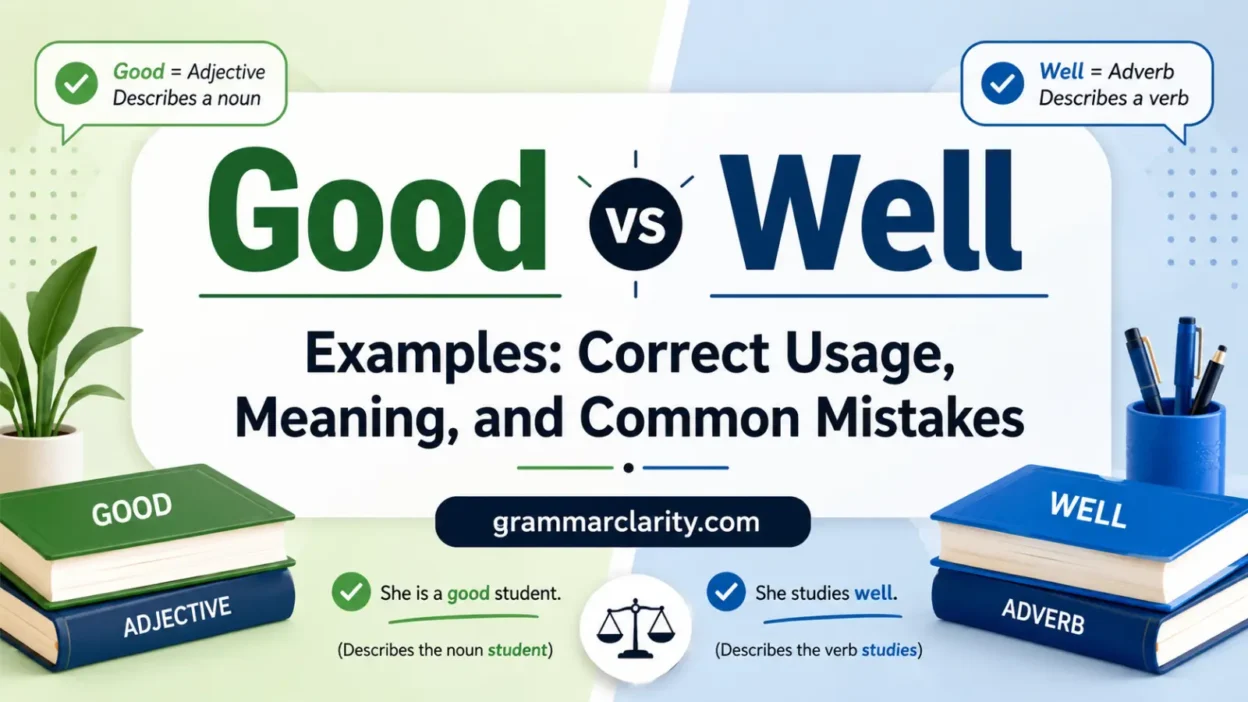
Good is usually an adjective.
Well is usually an adverb.
But real English use is a little more flexible than that.
This guide explains when each word works, when one sounds wrong, and how to use them naturally in everyday American English.
Quick Answer
Use good when describing a noun or person.
Use well when describing how something happens.
Examples:
- She is a good teacher.
- He plays basketball well.
- The movie was good.
- She sings well.
When talking about health, well often means healthy:
- I feel well today.
But in casual American speech, people also say:
- I’m doing good.
That phrase is common in conversation even though some style guides prefer doing well.
Why People Confuse Them
People confuse these words because they sometimes appear in similar places.
Compare:
- The food tastes good.
- He cooks well.
Both sentences are correct.
The confusion happens because some verbs describe states, while others describe actions.
Words like:
- look
- seem
- feel
- taste
- smell
often take good, not well.
Examples:
- You look good.
- The soup smells good.
- This coffee tastes good.
But action verbs usually take well:
- She writes well.
- He drives well.
- They performed well.
Key Differences At A Glance
| Context | Best Choice | Why |
|---|---|---|
| Describing a person | Good | Adjective describing a noun |
| Describing an action | Well | Adverb describing a verb |
| Talking about health | Well | Means healthy |
| Taste, smell, look verbs | Good | Describes condition or quality |
| Casual “How are you?” reply | Well / Good | Both appear in modern speech |
Quick Comparison
| Feature | Good | Well |
|---|---|---|
| Main role | Adjective | Adverb |
| Describes | Nouns | Verbs |
| Health meaning | Rare | Common |
| Formal preference | Standard | Standard |
Meaning and Usage Difference
Good mainly works as an adjective.
It describes quality, people, things, or situations.
Examples:
- That was a good idea.
- She is a good friend.
- We had a good weekend.
Well usually works as an adverb.
It describes how actions happen.
Examples:
- He speaks English well.
- She handled the meeting well.
- The team played well.
One important exception: well can also be an adjective when talking about health.
Examples:
- I’m finally well again.
- She does not feel well.
Parts of speech matter here:
- Good = adjective
- Well = mostly adverb, sometimes adjective
Tone, Context, and Formality
In formal writing, grammar guides usually prefer:
I’m doing well.
This means life is going fine.
But everyday American conversation often includes:
I’m doing good.
Many speakers use it naturally.
Examples:
Formal:
- I’m doing well, thank you.
Casual:
- I’m doing good lately.
Another difference appears with appearance:
Correct:
- You look good.
Less natural:
- You look well.
“You look well” usually suggests health rather than appearance.
Examples:
- You look well after your recovery.
- You look good in that jacket.
Which One Should You Use?
Choose good if you are describing:
- people
- objects
- quality
- appearance
- states
Examples:
- Good movie
- Good student
- Good weather
Choose well if you describe actions.
Examples:
- Run well
- Cook well
- Speak well
Quick memory rule:
Good = thing
Well = action
Health exception:
Well = healthy
Examples:
- She feels well now.
- He looks well after resting.
When One Choice Sounds Wrong
Some sentences immediately sound incorrect.
Wrong:
- She sings good.
Correct:
- She sings well.
Wrong:
- He drives good.
Correct:
- He drives well.
Wrong:
- I don’t feel good after surgery. (possible in casual speech but unclear)
Better:
- I don’t feel well.
Another common issue:
Wrong:
- The soup tastes well.
Correct:
- The soup tastes good.
“Taste” here describes quality, not action.
Common Mistakes (and Quick Fixes)
Mistake 1: Using good for actions
Wrong:
- She dances good.
Fix:
- She dances well.
Mistake 2: Using well after linking verbs
Wrong:
- The pie smells well.
Fix:
- The pie smells good.
Mistake 3: Mixing appearance and health meanings
Sentence:
- You look well.
Meaning: You appear healthy.
Sentence:
- You look good.
Meaning: You appear attractive or pleasant.
Mistake 4: Confusing health expressions
Natural:
- I feel well today.
Also common:
- I feel good today.
The first often focuses on health.
The second may suggest mood or overall feeling.
Everyday Examples
Work:
- Sarah gave a good presentation.
- Sarah presented well.
School:
- He is a good student.
- He writes essays well.
Food:
- The burger tastes good.
- She cooks well.
Sports:
- They played well yesterday.
- He is a good player.
Health:
- I feel well now.
- She looks well again.
Conversation:
Person A: How are you?
Person B: I’m doing well.
Casual answer:
Person B: I’m doing good.
Both are common in modern American speech.
Dictionary-Style Word Details
Verb
Good: Not commonly used as a verb in standard US English.
Well: Not commonly used as a verb in standard US English.
Noun
Good: Can function as a noun meaning benefit or positive value.
Examples:
- For the common good
- Do good for others
Well: Can function as a noun meaning a water source.
Example:
- Water well
This meaning is unrelated to the grammar comparison.
Synonyms
Good:
Closest plain alternatives:
- excellent
- positive
- quality
- fine
- pleasant
Possible antonyms:
- bad
- poor
Well:
Closest plain alternatives:
- properly
- effectively
- successfully
- skillfully
Health meaning alternatives:
- healthy
- recovered
Possible antonyms:
- poorly
- sick
Example Sentences
Good:
- That was a good decision.
- She bought a good laptop.
- We had a good time.
Well:
- He explained the project well.
- She performed well in class.
- I feel well today.
Word History
Good:
An old English word with long use related to positive quality and benefit.
Well:
Also comes from older English forms connected to ideas of being in a satisfactory condition or manner.
Exact historical details vary across language sources.
Phrases Containing
Good:
- Good job
- Good luck
- Good morning
- Good point
- Good news
Well:
- Well done
- Well prepared
- Well known
- Well informed
- Well behaved
Conclusion
The difference between good and well becomes easier once you remember their main jobs.
Use good for nouns, qualities, and states.
Use well for actions.
Examples:
- Good teacher
- Good movie
- Speaks well
- Writes well
Health is the main exception:
- I feel well.
And in everyday American conversation, phrases like “I’m doing good” still appear often.
When unsure, ask yourself:
Am I describing a thing or an action?
That answer usually gives you the correct choice.