The difference between few and a few looks tiny, but it changes meaning more than many people expect.
These two expressions both talk about small numbers, and both are used with countable plural nouns. Because they look almost identical, writers and learners often assume they mean exactly the same thing.
They do not.
Compare these two sentences:
I have few friends in the city.
I have a few friends in the city.
The first sentence sounds negative. It suggests there are not many friends and maybe fewer than expected.
The second sentence sounds more positive. It means there are some friends available.
That single letter “a” changes the whole message.
This guide explains the difference clearly, shows when each one works, fixes common mistakes, and gives real examples from everyday American English.
Quick Answer
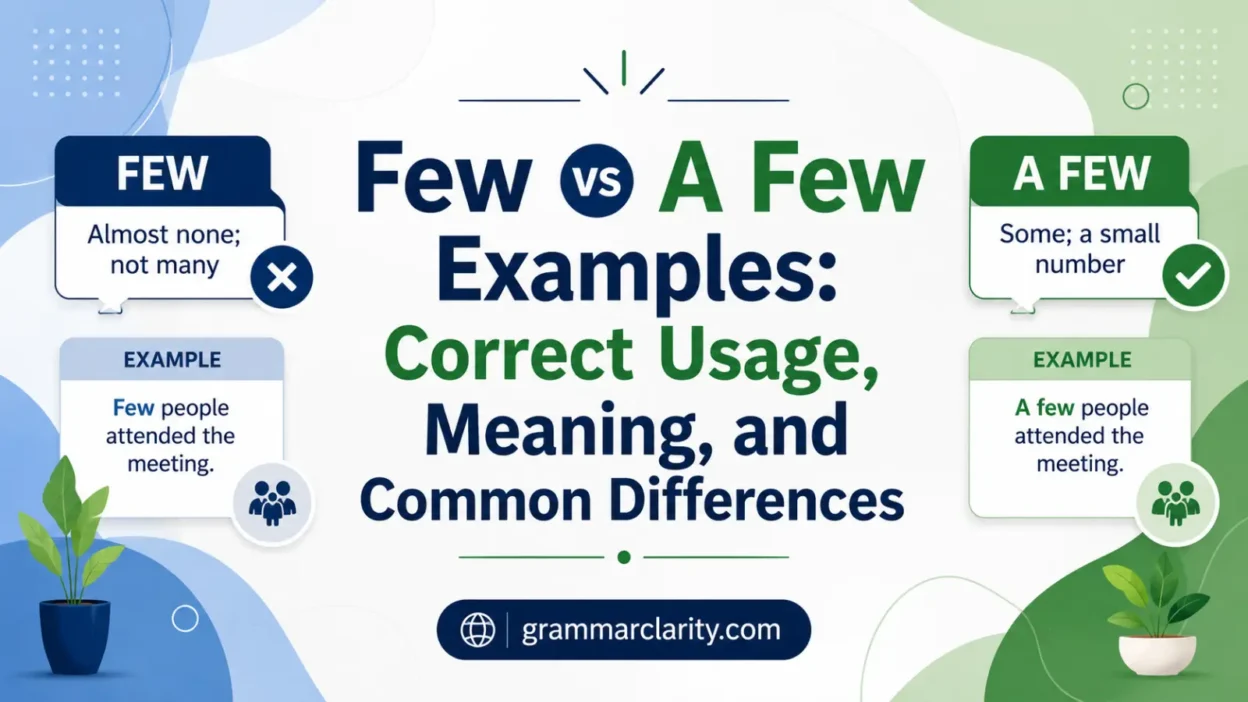
Use few when you mean not many and want to emphasize shortage, limitation, or lack.
Use a few when you mean some or a small number without focusing on shortage.
Examples:
Few employees attended the meeting.
Meaning: attendance was low.
A few employees attended the meeting.
Meaning: some people attended.
Simple rule:
few = almost not enough
a few = some exist
Why People Confuse Them
People confuse these expressions because both describe small amounts of countable things.
You can use both with plural nouns:
- few books
- a few books
- few emails
- a few emails
- few people
- a few people
The structure stays almost identical.
The difference comes from tone and meaning, not grammar alone.
Look at this example:
Few customers returned.
This sounds disappointing.
Now compare:
A few customers returned.
This sounds more hopeful.
The quantity may even be similar, but the feeling changes.
Many learners focus only on numbers and miss the emotional difference.
That is where confusion usually happens.
Key Differences At A Glance
| Feature | few | a few |
|---|---|---|
| Main meaning | not many | some |
| Tone | negative | positive or neutral |
| Focus | shortage | existence |
| Feeling | limited amount | available amount |
| Example | Few guests arrived | A few guests arrived |
| Reader impression | disappointing | acceptable |
Meaning and Usage Difference
The clearest difference is this:
Few focuses on what is missing.
A few focuses on what exists.
Meaning of “few”
Few means not many.
It often suggests the amount is smaller than expected.
Examples:
Few people understood the joke.
Few stores remained open.
Few students missed class.
Few workers volunteered.
These examples sound like the amount was limited.
The sentence carries a slight negative feeling.
Meaning of “a few”
A few means some.
The amount is still small, but the sentence feels more positive.
Examples:
A few people understood the joke.
A few stores remained open.
A few students missed class.
A few workers volunteered.
Now the message changes.
The focus becomes:
“There were at least some.”
Compare the meaning directly
Few restaurants stayed open after midnight.
Meaning: almost none stayed open.
A few restaurants stayed open after midnight.
Meaning: some stayed open.
Another example:
Few friends called me.
Meaning: not many called.
A few friends called me.
Meaning: some friends called.
The difference may look small, but readers hear it immediately.
Countable nouns only
Both expressions work with countable plural nouns.
Correct:
- few books
- few people
- few chairs
- a few cars
- a few ideas
- a few emails
Incorrect:
few water
few sugar
a few rice
For uncountable nouns, English usually uses little and a little instead.
Examples:
Little water remained.
A little water remained.
Tone, Context, and Formality
Tone matters a lot with these expressions.
Few sounds more negative
Sentence:
Few opportunities exist in this town.
This sounds limiting.
The reader hears shortage.
Another example:
Few people supported the proposal.
The speaker seems disappointed.
A few sounds more positive
Sentence:
A few opportunities exist in this town.
Now the sentence sounds hopeful.
It suggests possibilities still exist.
Example:
A few people supported the proposal.
The focus moves from lack to presence.
Workplace examples
Few employees attended training.
This sounds like attendance was poor.
A few employees attended training.
This simply reports attendance.
School examples
Few students finished early.
Not many finished.
A few students finished early.
Some finished.
Daily conversation examples
I have few free weekends.
Meaning: almost no free time.
I have a few free weekends.
Meaning: some weekends are open.
The grammar stays the same, but the mood changes.
Which One Should You Use?
Choose few when you want to emphasize limitation.
Use it when discussing:
- shortages
- low numbers
- disappointment
- scarcity
- rare situations
Examples:
Few houses survived the storm.
Few people knew the answer.
Few workers applied.
Few stores were open.
Choose a few when you simply mean “some.”
Examples:
A few houses survived.
A few people knew the answer.
A few workers applied.
A few stores remained open.
Quick memory trick:
few = less than hoped
a few = enough to mention
When One Choice Sounds Wrong
Sometimes using the wrong one changes the entire sentence.
Example:
I have a few questions.
This sounds natural.
It means some questions exist.
Now compare:
I have few questions.
This sounds unusual in many situations.
It suggests almost no questions exist.
Another example:
A few guests arrived early.
Some arrived.
Few guests arrived early.
Almost nobody arrived.
Same grammar.
Different message.
Compare these pairs
Few people attended the concert.
Attendance was poor.
A few people attended the concert.
Some attended.
Few neighbors helped.
Not many helped.
A few neighbors helped.
Some helped.
Few students passed.
Results were low.
A few students passed.
At least some passed.
Common Mistakes (and Quick Fixes)
Mistake 1: Thinking they mean exactly the same thing
Wrong idea:
few = a few
Correct idea:
few = shortage
a few = some
Mistake 2: Using them with uncountable nouns
Incorrect:
Few milk remained.
Correct:
Little milk remained.
Incorrect:
A few sugar packets spilled.
Correct:
A little sugar spilled.
Mistake 3: Ignoring sentence tone
Sentence:
Few people replied.
This sounds disappointing.
If you only mean “some,” write:
A few people replied.
Mistake 4: Using singular nouns
Incorrect:
few book
a few chair
Correct:
few books
a few chairs
Mistake 5: Missing context
Sentence:
Few employees arrived.
The company may have staffing issues.
Sentence:
A few employees arrived.
The report simply states attendance.
Context changes meaning.
Everyday Examples
Examples with “few”
Few players arrived on time.
Few people noticed the update.
Few workers stayed late.
Few customers complained.
Few restaurants remained open.
Few teachers missed class.
Few neighbors attended.
Few students volunteered.
Few houses were damaged.
Few drivers stopped.
Examples with “a few”
A few players arrived on time.
A few people noticed the update.
A few workers stayed late.
A few customers complained.
A few restaurants remained open.
A few teachers missed class.
A few neighbors attended.
A few students volunteered.
A few houses were damaged.
A few drivers stopped.
Daily life comparisons
Few relatives visited last year.
Not many visited.
A few relatives visited last year.
Some visited.
Few guests remained.
Almost none remained.
A few guests remained.
Some remained.
Few coworkers agreed.
Not many agreed.
A few coworkers agreed.
Some agreed.
Dictionary-Style Word Details
Verb
few: Not commonly used as a verb in standard American English.
a few: Not used as a verb in standard American English.
Noun
few: Can act like a pronoun substitute.
Example:
Few attended.
Meaning: few people attended.
a few: Can also replace the noun when context is obvious.
Example:
A few stayed after class.
Meaning: a few students stayed.
Synonyms
Few
Closest plain alternatives:
- not many
- hardly any
- limited number
- scarce amount
Possible opposite ideas:
- many
- numerous
A Few
Closest plain alternatives:
- some
- several
- a small number
Possible opposite ideas:
- none
- no one
Example Sentences
Few
Few stores stayed open.
Few employees volunteered.
Few people answered.
Few houses sold quickly.
Few students missed class.
A Few
A few stores stayed open.
A few employees volunteered.
A few people answered.
A few houses sold quickly.
A few students missed class.
Word History
Few comes from older English words connected to the idea of a small amount or limited number.
A few developed from the same expression with the added article “a.”
Modern English mainly distinguishes them by tone and emphasis.
Phrases Containing
Few
few and far between
very few
few people
few options
few chances
A Few
a few days
a few minutes
a few ideas
a few friends
a few questions
Frequently Asked Questions
Is “few” negative?
Usually yes.
It often suggests shortage or lack.
Example:
Few workers arrived.
This sounds like attendance was lower than expected.
Is “a few” positive?
Usually yes.
It means some exist.
Example:
A few workers arrived.
This sounds more encouraging.
Can “few” and “a few” be interchangeable?
Not usually.
Changing them changes tone and meaning.
Compare:
Few people attended.
Not many attended.
A few people attended.
Some attended.
Do they work with singular nouns?
No.
Both normally use plural countable nouns.
Correct:
few students
a few books
Incorrect:
few student
a few chair
Can they be used in formal writing?
Yes.
Both appear in:
- business writing
- academic writing
- news reports
- everyday conversation
The difference stays the same.
What is the easiest way to remember them?
Think:
few = almost none
a few = some
That simple rule works in most situations.
Conclusion
The difference between few and a few is not grammar alone.
It is mainly about meaning and tone.
Use few when you want to show scarcity, limitation, or disappointment.
Use a few when you simply mean some.
Final comparison:
Few people called.
Almost nobody called.
A few people called.
Some people called.
That small article “a” changes the entire feeling of the sentence.