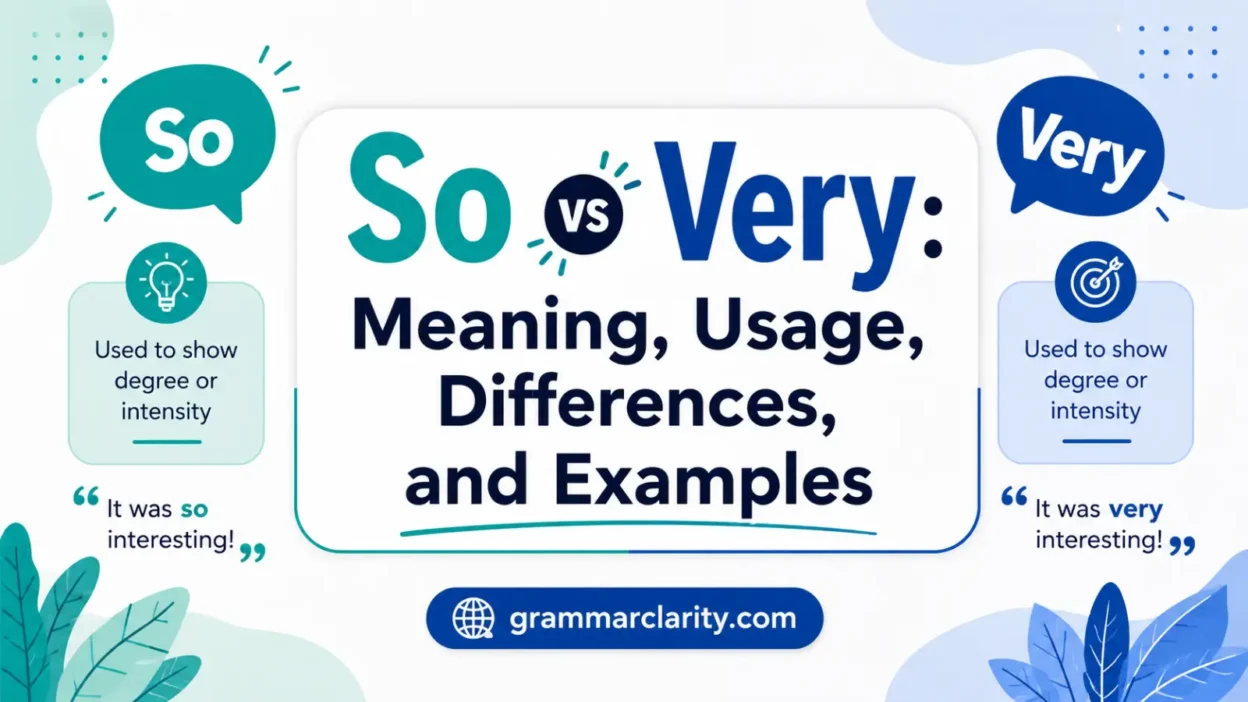
Many English learners wonder whether they should use so or very. Both words are common intensifiers that make adjectives and adverbs stronger. Because they often appear in similar situations, people frequently confuse them.
While so and very can sometimes express a similar level of emphasis, they are not always interchangeable. The choice depends on the sentence structure, the speaker’s intention, and the amount of emphasis being communicated.
Understanding the difference between these two words helps you sound more natural and avoid common mistakes in everyday English.
Quick Answer
Both so and very intensify adjectives and adverbs.
- Use very when you simply want to strengthen a description.
- Use so when you want stronger emotion, emphasis, or when a result follows.
Examples:
- The movie was very interesting.
- The movie was so interesting that I watched it twice.
In many cases, very sounds neutral, while so sounds more emotional or expressive.
Why People Confuse Them
People confuse so and very because both can appear before adjectives and adverbs.
Consider these examples:
- She is very happy.
- She is so happy.
Both sentences are grammatically correct. Both indicate a high degree of happiness.
The confusion begins because learners often assume they mean exactly the same thing in every context. In reality, they create different tones and sometimes require different sentence structures.
Another reason for confusion is that spoken American English frequently uses so for emphasis:
- That’s so good.
- I’m so excited.
- It was so funny.
Because native speakers use so often in conversation, learners may start replacing very everywhere, which can lead to awkward sentences.
Key Differences At A Glance
| Context | Best Choice | Why |
|---|---|---|
| Neutral description | Very | Simple intensifier |
| Emotional emphasis | So | Stronger feeling |
| Cause-and-result structure | So | Often followed by “that” |
| Formal writing | Very | Usually sounds more neutral |
| Casual conversation | So | Common and expressive |
| Academic writing | Very | Often preferred for clarity |
| Strong reaction | So | Adds emotional force |
| Straightforward statement | Very | Sounds balanced |
Quick Comparison
| Feature | So | Very |
|---|---|---|
| Strength of emphasis | Stronger | Moderate |
| Emotional tone | Higher | Lower |
| Common in conversation | Yes | Yes |
| Often followed by “that” clause | Yes | No |
| Neutral description | Sometimes | Yes |
| Expressive speech | Very common | Less common |
Meaning and Usage Difference
The main difference between so and very lies in emphasis and sentence purpose.
Using “Very”
Very simply increases the degree of an adjective or adverb.
Examples:
- The restaurant was very busy.
- He drives very carefully.
- The test was very difficult.
- She was very polite.
In these examples, very strengthens the description without adding extra emotion.
Using “So”
So also increases intensity, but it often adds emotion, surprise, excitement, or strong feeling.
Examples:
- The restaurant was so busy.
- He was so kind.
- The concert was so amazing.
- She looked so happy.
These sentences feel more expressive than versions using very.
Cause-and-Result Structure
One of the most important uses of so is introducing a result.
Examples:
- The road was so icy that schools closed.
- She was so tired that she fell asleep immediately.
- The food was so spicy that nobody finished it.
This pattern is extremely common:
so + adjective/adverb + that + result
Using very in this structure is usually incorrect.
Incorrect:
- The road was very icy that schools closed.
Correct:
- The road was so icy that schools closed.
Degree of Emphasis
Compare:
- The game was very exciting.
- The game was so exciting.
Both are correct.
The second sentence sounds more emotional and enthusiastic.
Tone, Context, and Formality
Tone plays a major role in choosing between these words.
Very Sounds More Neutral
Very works well when you want to sound objective.
Examples:
- The report was very detailed.
- The data was very useful.
- The presentation was very informative.
These sentences sound professional and balanced.
So Sounds More Emotional
So often communicates personal feelings.
Examples:
- The report was so interesting.
- The trip was so much fun.
- That was so unexpected.
The speaker sounds more engaged emotionally.
Formal Writing
In formal writing, very is often preferred because it sounds less emotional.
Examples:
- The findings were very significant.
- The results were very encouraging.
Using so in these situations may sound conversational.
Casual Conversation
In everyday American English, so is extremely common.
Examples:
- That’s so cool.
- I’m so glad you’re here.
- This pizza is so good.
These expressions sound natural and friendly.
Which One Should You Use?
Choosing between so and very becomes easier when you ask yourself a simple question:
Do I want neutral emphasis or strong emotional emphasis?
Use very when:
- Writing formally
- Describing something objectively
- Making straightforward statements
- Avoiding excessive emotion
Examples:
- The instructions were very clear.
- The equipment is very reliable.
- The teacher was very helpful.
Use so when:
- Showing excitement
- Expressing strong feelings
- Adding emotional emphasis
- Introducing a result
Examples:
- The teacher was so inspiring.
- I’m so happy for you.
- The weather was so bad that flights were delayed.
When One Choice Sounds Wrong
Sometimes both words work.
Example:
- The cake is very good.
- The cake is so good.
Both are natural.
However, there are situations where only one sounds correct.
Result Clauses
Correct:
- The cake was so good that everyone wanted more.
Incorrect:
- The cake was very good that everyone wanted more.
Excessive Informality
In some professional writing, so may sound overly conversational.
Less suitable:
- The study was so important.
Better:
- The study was very important.
Emotional Context
When strong emotion is intended, very may sound weaker.
Compare:
- I was very excited.
- I was so excited.
The second sentence communicates more enthusiasm.
Common Mistakes (and Quick Fixes)
Mistake 1: Using Very Before “That” Results
Incorrect:
- The movie was very interesting that I watched it twice.
Correct:
- The movie was so interesting that I watched it twice.
Mistake 2: Using So Everywhere
Incorrect:
- The report was so accurate.
- The analysis was so detailed.
These may be acceptable, but in professional contexts, very often sounds better.
Better:
- The report was very accurate.
- The analysis was very detailed.
Mistake 3: Ignoring Tone
Learners sometimes use very when they want strong emotion.
Less expressive:
- I was very surprised.
More expressive:
- I was so surprised.
Mistake 4: Assuming They Always Mean the Same Thing
Although similar, they create different impressions.
Compare:
- She’s very talented.
- She’s so talented.
The second sentence sounds more enthusiastic.
Everyday Examples
Here are realistic examples showing how native speakers use both words.
At Work
- The meeting was very productive.
- The client was very satisfied.
- The presentation was so impressive.
- The solution was so effective that management adopted it immediately.
At School
- The assignment was very challenging.
- The professor was very supportive.
- The lecture was so interesting that nobody checked their phones.
With Friends
- Your new car is so nice.
- That movie was so funny.
- The restaurant was very clean.
- The service was very professional.
Family Conversations
- I’m so proud of you.
- Grandma was very happy to see everyone.
- The children were so excited about the trip.
- Dinner was very delicious.
Travel Situations
- The hotel was very comfortable.
- The beach was so beautiful.
- The weather was very pleasant.
- The sunset was so amazing that everyone stopped to take photos.
Dictionary-Style Word Details
Verb
So: Not commonly used as a verb in standard US English.
Very: Not commonly used as a verb in standard US English.
Noun
So: Not commonly used as a noun in standard US English.
Very: Not commonly used as a noun in standard US English.
Synonyms
So (closest plain alternatives):
- Extremely
- Really
- Exceptionally
- Remarkably
- Incredibly
Very (closest plain alternatives):
- Extremely
- Quite
- Highly
- Really
- Particularly
Antonyms that may fit some contexts:
- Slightly
- Somewhat
- Barely
- Mildly
These are not direct opposites in every situation but can express lower intensity.
Example Sentences
So
- The concert was so loud.
- I’m so grateful for your help.
- The traffic was so heavy that we arrived late.
- She looked so confident during the interview.
- That was so thoughtful of you.
Very
- The concert was very loud.
- I’m very grateful for your help.
- The traffic was very heavy.
- She was very confident during the interview.
- The manager was very supportive.
Word History
So: An old English word that has long been used to indicate degree, manner, or result. It remains one of the most common intensifiers in modern English.
Very: Developed through historical changes in English and eventually became a common intensifier meaning “to a high degree.” It is now widely used in both spoken and written English.
Phrases Containing
So
- So far
- So much
- So many
- So good
- So long
- So that
- So what
- So be it
Very
- Very good
- Very well
- Very often
- Very little
- Very likely
- Very important
- Very carefully
FAQs
Is it correct to say “so happy” or “very happy”?
Both are correct. Very happy sounds neutral, while so happy sounds more emotional and expressive.
Can “so” replace “very” in every sentence?
No. Although both intensify meaning, so is often used for stronger emotion or result clauses, while very is better for neutral descriptions.
Which is more formal, so or very?
Very generally sounds more formal and objective. So often sounds more conversational.
Why do native speakers say “so” so often?
Native speakers frequently use so because it adds warmth, emotion, and emphasis to everyday speech.
Can I say “very good” and “so good”?
Yes. Both are correct. Very good sounds more neutral, while so good sounds more enthusiastic.
Is “very” weaker than “so”?
In many situations, yes. So usually conveys stronger emotion and emphasis than very.
Can “so” be followed by “that”?
Yes. This is one of its most common grammatical patterns.
Example:
- The weather was so cold that the lake froze.
Which should English learners use more often?
Learn both. Use very for clear, neutral descriptions and so when expressing strong feelings or introducing results.
Conclusion
The difference between so and very is mainly about emphasis and tone. Both intensify adjectives and adverbs, but they do not always create the same effect.
Use very when you want a clear, neutral description. It works especially well in professional, academic, and factual writing.
Use so when you want stronger emotion, enthusiasm, surprise, or when introducing a result with a that clause.
A simple way to remember the distinction is this:
- Very = strong but neutral
- So = strong and emotional
Once you recognize this difference, choosing between so and very becomes much easier, and your English will sound more natural in both writing and conversation.