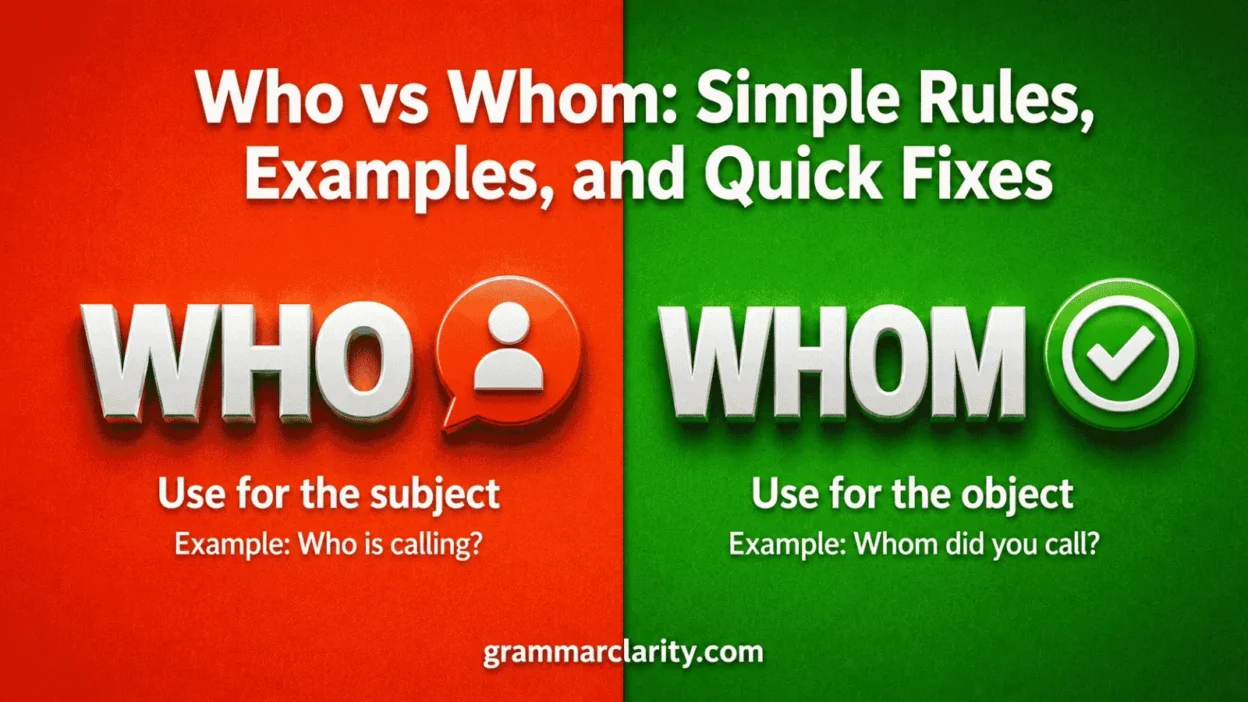
Who vs whom is a choice between two pronoun forms. Use who when the word is doing the action or acting as the subject. Use whom when the word is receiving the action or following a preposition.
The easiest shortcut is this: if you could replace the word with he, she, or they, use who. If you could replace it with him, her, or them, use whom.
Quick Answer
Use who for the subject of a sentence or clause.
Use whom for the object of a verb or preposition.
Examples:
- Who called you?
- You called whom?
- The manager who approved the request is out today.
- The client whom we emailed has not responded.
- To whom should I send the form?
In everyday American speech, who often replaces whom, especially in casual questions. In formal writing, polished business writing, legal writing, and academic contexts, whom is still useful when it clearly functions as an object.
Why People Confuse Them
People confuse who and whom because both refer to people, and modern speech often favors who even where traditional grammar would call for whom.
The problem gets harder when the sentence has more than one clause:
- The person who I thought was in charge left early.
- The person whom I called left early.
In the first sentence, who is the subject of “was in charge.” In the second, whom is the object of “called.”
The real question is not whether the person is doing something somewhere in the sentence. The real question is what job who or whom is doing in its own clause.
Key Differences At A Glance
| Context | Best Choice | Why |
|---|---|---|
| The word performs the action | who | It acts as the subject |
| The word receives the action | whom | It acts as the object |
| The word follows a preposition | whom | It is the object of the preposition |
| Casual speech | who | It sounds more natural in many everyday questions |
| Formal writing | whom | It may be expected when the object form is clear |
| Fixed formal phrases | whom | Some expressions still preserve the older form |
Compact comparison:
- Who = subject form.
- Whom = object form.
- Who sounds natural in most everyday speech.
- Whom sounds more formal and is strongest after prepositions.
- Who pairs with he, she, or they.
- Whom pairs with him, her, or them.
Meaning and Usage Difference
Who asks about or identifies a person performing an action.
Examples:
- Who signed the lease?
- Who is leading the meeting?
- She is the analyst who found the error.
In each case, who is connected to the person doing something.
Whom asks about or identifies a person receiving an action.
Examples:
- Whom did you invite?
- The attorney whom we hired starts Monday.
- I met the neighbor whom you mentioned.
In each case, someone else is acting on the person referred to by whom.
A quick test helps:
- Who called? → She called.
- You called whom? → You called her.
If she fits, use who. If her fits, use whom.
Tone, Context, and Formality
Who is the normal choice in most everyday American conversation. Even when whom is technically possible, it can sound stiff in casual speech.
Natural:
- Who did you talk to?
- Who should I ask?
- Who are they hiring?
More formal:
- To whom did you speak?
- Whom should I ask?
- Whom are they hiring?
The formal versions are correct, but they may sound too polished for casual conversation. In business, academic, editorial, and legal contexts, whom can still be the better choice when precision and formality matter.
A good practical rule: use whom when it improves clarity or fits the tone. Do not force it into casual writing where it makes the sentence sound unnatural.
Which One Should You Use?
Use who when the word is the subject:
- Who sent the invoice?
- The employee who trained me was patient.
- Who wants the last slice?
Use whom when the word is the object:
- Whom did you recommend?
- The candidate whom we interviewed was impressive.
- The professor whom she thanked smiled.
Use whom after a preposition:
- For whom is this package?
- With whom are you meeting?
- To whom it may concern.
In casual writing, it is often better to move the preposition to the end and use who:
- Who is this package for?
- Who are you meeting with?
That version is less formal, but it sounds more natural in everyday American English.
When One Choice Sounds Wrong
Whom sounds wrong when it is used as a subject.
Incorrect:
- Whom is coming to dinner?
- The person whom manages payroll is out.
Correct:
- Who is coming to dinner?
- The person who manages payroll is out.
Who can sound too casual when it follows a preposition in formal writing.
Casual:
- Who did you send it to?
Formal:
- To whom did you send it?
Both can be acceptable depending on tone. The formal version is more polished, while the casual version is more conversational.
The biggest mistake is using whom just because the sentence sounds formal. Formality does not decide the grammar. The word’s job in the clause does.
Common Mistakes (and Quick Fixes)
Mistake: using whom as the subject.
- Incorrect: Whom approved the budget?
- Correct: Who approved the budget?
Mistake: using who after a fronted preposition in formal writing.
- Casual: Who was the letter addressed to?
- Formal: To whom was the letter addressed?
Mistake: choosing by sound alone.
- Incorrect: The woman whom I believe is the owner just arrived.
- Correct: The woman who I believe is the owner just arrived.
Here, who is the subject of “is the owner.” The phrase “I believe” interrupts the sentence, but it does not make who an object.
Quick fix: isolate the clause.
- Who is the owner?
- She is the owner.
Because she fits, who is correct.
Everyday Examples
- Who made the reservation?
- Whom did the restaurant call to confirm?
- Who is joining us for lunch?
- Whom should we contact about the refund?
- The coworker who helped me deserves credit.
- The coworker whom I helped sent a thank-you note.
- Who left their phone in the conference room?
- To whom should I address the cover letter?
- Who do you think will win?
- Whom did the committee choose?
The sentence “Who do you think will win?” is a common trap. Who is correct because it is the subject of “will win.” The words “do you think” do not turn it into an object.
Dictionary-Style Word Details
Verb
Neither who nor whom is a verb. Both are pronoun forms. They help ask about or refer to people.
In a sentence, the verb is the action or state:
- Who called?
- You called whom?
In the first example, called is the verb, and who is the subject. In the second, called is still the verb, and whom is the object.
Noun
Neither word is a noun, but both can stand in for a person or people.
- Who is at the door?
- The person whom you requested is available.
Think of who and whom as pronouns that point to people, not as names for people, places, or things.
Synonyms
There are no perfect one-word synonyms for who and whom because their grammar role matters. Depending on the sentence, you may be able to rephrase with:
- which person
- what person
- the person who
- the person whom
- the people who
- the people whom
Examples:
- Who called? → Which person called?
- Whom did you invite? → Which person did you invite?
These rewrites can help clarify meaning, but they do not always sound natural.
Example Sentences
- Who is responsible for this project?
- Who gave you the update?
- The nurse who checked us in was kind.
- Whom did you list as your emergency contact?
- The speaker whom we invited canceled.
- With whom did you share the file?
- Who do you believe is right?
- Whom do you trust with that decision?
Word History
Who and whom are older English pronoun forms that preserve a subject-object distinction. In current American English, who remains common in both speech and writing, while whom is more limited and formal.
That is why the traditional rule still matters, but tone matters too. A sentence can be grammatically correct and still sound too stiff for the setting.
Phrases Containing
Common phrases with who:
- who knows
- who cares
- guess who
- people who
- someone who
Common phrases with whom:
- to whom it may concern
- for whom the bell tolls
- with whom
- to whom
- from whom
Some whom phrases sound formal because they preserve a traditional preposition-plus-object structure.
Conclusion
The difference between who vs whom comes down to grammar role. Use who for the subject and whom for the object.
The simplest test is he/she/they versus him/her/them. If he, she, or they fits, choose who. If him, her, or them fits, choose whom.
For everyday American English, who usually sounds more natural. For formal writing, especially after prepositions, whom still has a clear place. The best choice is the one that is grammatically right and appropriate for the tone.